
If you run a small business, you already know how this happens. The phone rings while your team is helping a customer, handling a job, checking in a patient, or simply trying to catch up. Then the call is missed.
That missed call may have been a new lead, a ready to book customer, or someone comparing you with two other businesses. When that happens over and over, the real cost is not just one unanswered call. It is lost leads, missed bookings, slow response, and wasted marketing effort.
This guide will show you a practical system for using an AI receptionist for small business to improve 24/7 lead capture, handle after hours inquiries, recover missed calls, and move more callers into booked appointments. I'll also walk through templates, workflows, and what LEADSORBIT can do to support that process in a practical way.
Why Missed Calls Are Costing Your Customers?
For many small businesses, missed calls are not a phone problem. They are a growth problem.
A caller usually reaches out when they want something quickly:
- To book an appointment
- To ask about pricing
- To confirm whether you offer a service
- To see if someone can help today
- To compare you with another provider before deciding
If nobody answers, the lead often moves on. Some will not leave a voicemail. Some will not call again. Some will send a message elsewhere. And if the inquiry comes in after hours, that gap gets even bigger by the next morning.
This is why so many owners feel frustrated. They are spending time and money to generate demand, but the business still leaks opportunities because the response process is weak. That shows up as:
- Lost leads
- Missed bookings
- Inconsistent follow up
- Scattered conversations across calls, texts, email, and DMs
- Front desk stress and owner overwhelm
For local businesses and appointment based businesses, the impact is even more visible.
A clinic may miss a new patient because the team was busy in the office. A med spa may lose a consultation because no one replied after treatment hours. An HVAC business may miss a high intent service request while technicians are out in the field. A plumbing company may lose a job because another provider answered faster.
The common thread is simple: leads are being generated, but they are not being captured and converted consistently.
That is why a real system matters. Not just a tool. Not just a script. A full response system that can support the team during business hours, after hours, and during busy periods.
Why Small Businesses Lose Leads from Missed Calls?
Most owners do not create this problem on purpose. It happens because the business grows faster than the process.
Here are the most common causes.
- Calls are handled separately from the rest of the lead process. Forms, chats, and DMs may have some kind of follow up, but phone calls are still treated manually.
- There is no clear after hours answering service process. Many businesses rely on voicemail and hope someone checks it early enough.
- Missed calls do not trigger an automatic next step. No text back, no task, no callback workflow, no status update.
- Lead response time depends on staff availability. If someone is free, the lead gets helped. If not, the lead waits.
- Intake questions are inconsistent. One team member asks the right things. Another forgets key details. That makes follow up messy.
- Booking is disconnected from the conversation. The lead has to wait for a callback or go through extra steps just to get scheduled.
- Too many tools are being used. Calls in one place, SMS in another, calendar elsewhere, email on a separate login. That creates scattered inboxes and missed context.
- Nobody owns the follow up workflow clearly. Everyone assumes someone else is handling it.
Once those issues stack together, the business ends up with two big problems:
- Fewer leads get converted into appointments
- The team works harder than necessary just to keep up
How an AI Receptionist Solves the Problem
The answer is not just to “answer more calls.” The answer is to build a repeatable workflow that captures, converts, and controls inbound demand.
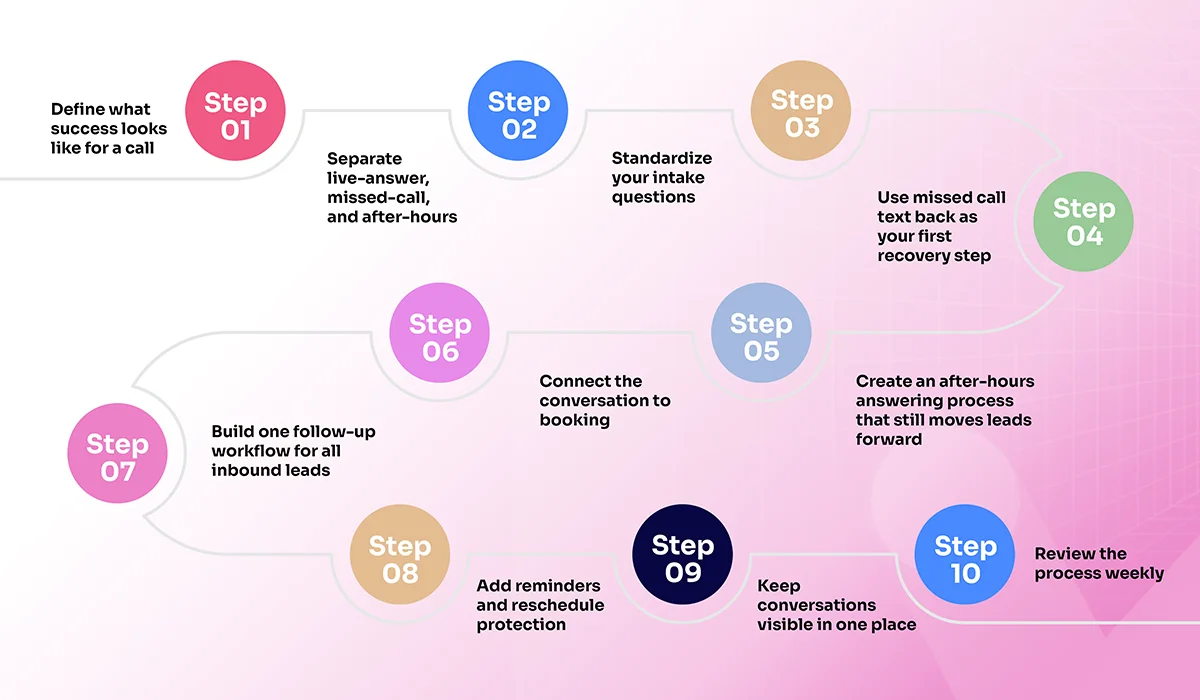
Step 1: Define what success looks like for a call
Before setting up any automation, decide what outcome you want from inbound calls.
Examples:
- A clinic wants a booked consultation
- A med spa wants a consultation request or service booking
- An HVAC business wants a service request captured and routed
- A plumbing company wants urgency, location, and callback details
- A pet grooming business wants the appointment inquiry moved into the calendar flow
This matters because not every call needs a long conversation. Every call does need a clear next step.
Step 2: Separate live answer, missed call, and after hours workflows
These should not all be handled the same way.
Live answer flow
- Greet
- Confirm what the caller needs
- Ask intake questions
- Book or route
Missed call flow
- Trigger a missed call text back
- Create a lead record
- Notify the team
- Set a callback task
After hours flow
- Acknowledge the inquiry
- Capture the caller’s need
- Offer the next step
- Create follow up for the next business window
This is where an AI Receptionist becomes useful. It helps your business stay responsive even when a person is unavailable.
Step 3: Standardize your intake questions
A good system depends on consistent information capture.
At minimum, most service businesses should capture:
- Full name
- Phone number
- Service needed
- Preferred day or time
- Urgency level
- Location or service area if relevant
- Notes that matter for follow up
For appointment based businesses, you may also want:
- New or existing patient/customer
- Preferred provider or service type
- Insurance or payment question if relevant
- Preferred branch or location
This is one of the biggest advantages of AI phone answering when it is configured well. It asks the same smart questions every time.
Step 4: Use missed call text back as your first recovery step
This is one of the simplest and most effective workflow upgrades for a small business.
If a call is missed, the business should not go silent. A fast message should go out that:
- Acknowledges the missed call
- Offers help
- Keeps the conversation open
- Provides a booking path when appropriate
That is what missed call text back does. It turns a dead end call into an active lead conversation.
Step 5: Create an after hours answering process that still moves leads forward
A real after hours answering service process does more than say “we’re closed.”
It should:
- Acknowledge the caller right away
- Collect basic details
- Offer a booking path if possible
- Set expectations for follow up timing
- Create a task or inbox item for the team
That way, after hours inquiries still become part of your lead pipeline instead of getting lost overnight.
Step 6: Connect the conversation to booking
Do not make callers take extra steps if they are ready.
If a lead is qualified, they should be moved toward booking quickly through your AI Appointment workflow.
That means:
- Present the booking option clearly
- Attach intake notes to the lead
- Confirm the booking
- Move the lead into reminders
This is where a lot of businesses lose momentum. The caller is interested, but the booking handoff is too slow or too manual.
Step 7: Build one follow up workflow for all inbound leads
A missed call is still a lead. So is an after hours inquiry. So is a text response after a missed call.
Use one simple follow up model:
- Instant acknowledgment
- First callback attempt
- Second touch if needed
- Optional email if available
- Clear lead status update
- Close the loop rule if no response after defined attempts
The goal is not complexity. The goal is consistency.
Step 8: Add reminders and reschedule protection
A lead is not fully converted until the appointment actually happens.
That means your workflow should also include:
- Booking confirmation
- Reminder sequence
- Reschedule path
- Follow up for no shows or missed appointments
This is especially important for clinics, med spas, and pet grooming businesses where one no show can affect the schedule and revenue for the day.
Step 9: Keep conversations visible in one place
If calls, texts, and follow up tasks are scattered, your team will miss context.
That is why owners often benefit from Conversation AI and a more unified conversation flow. It helps reduce scattered inboxes and makes it easier to see what happened with a lead.
Step 10: Review the process weekly
Once this system is in place, do not leave it alone for months.
Check:
- How many calls were missed
- How many were recovered
- How many became two way conversations
- How many became appointments
- Where the delays are happening
- Where the team is getting stuck
This turns the system into something you can improve week by week instead of just react to when business feels slow.
A good next step for owners who want to see this in action is to request a Free Mockup based on their actual workflow.
Suggested Templates
Here are practical templates you can actually use.
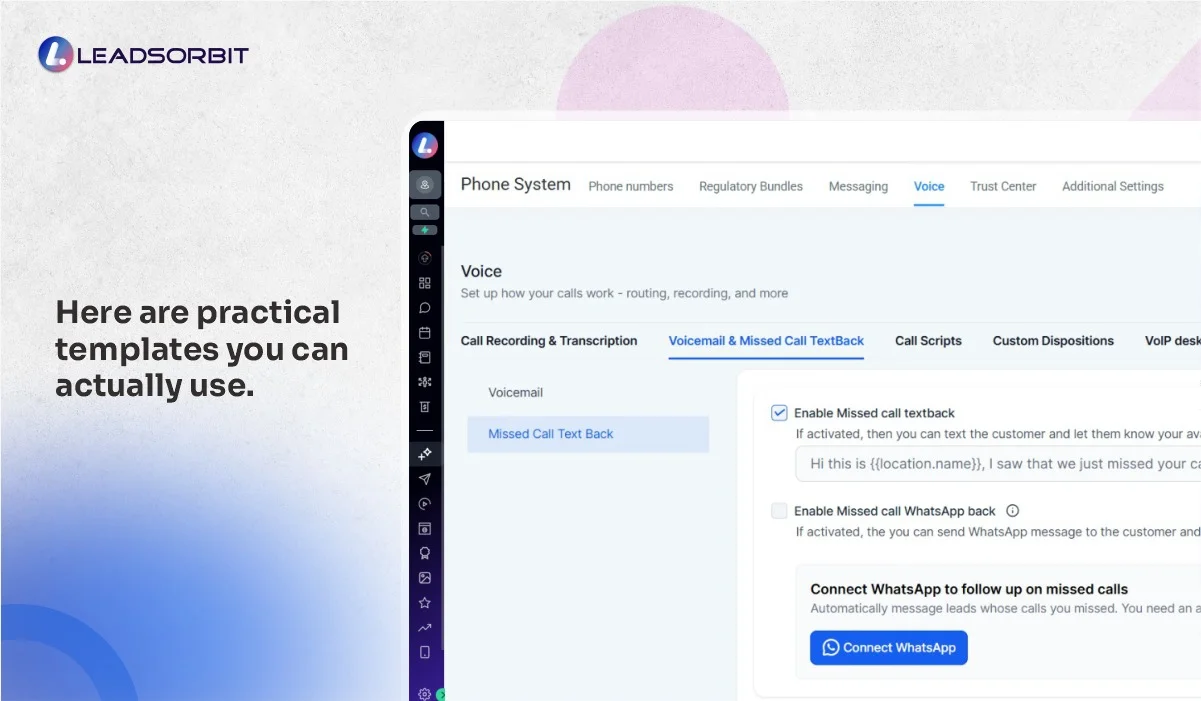
Missed Call Text Back Template
Copy/paste version:

Why this works:
- Short
- Clear
- Immediate
- Keeps the lead warm
- Offers the next step without pressure
After Hours Response Template
Copy/paste version:
Best for:
- Clinics
- Med spas
- Pet grooming
- Local services with scheduled appointments
Staff Callback Script
Copy/paste version:
Then ask:
- What service are you looking for?
- Are you a new or existing customer?
- What day or time works best for you?
- Is there anything important we should know before booking?
Quick Intake Checklist
Use this for every new inbound inquiry:
- Full name
- Phone number
- Service needed
- New or existing customer
- Preferred day/time
- Location or branch if relevant
- Notes or urgency
- Booking completed or follow up needed
- Reminder path set if booked
Daily Missed Call SOP
Use this at the start and end of each day:
- Review all missed calls from the past 24 hours
- Confirm missed call automation triggered
- Call back all unbooked leads
- Update lead status
- Move booked leads into reminder flow
- Move unresponsive leads into next follow up step
- Review after hours leads first thing next business day
Try LEADSORBIT free for 14 days
Key KPIs to Track for Better Conversions
You do not need dozens of numbers. You need a few practical KPIs that show whether your system is improving.
Missed Call Rate
- Definition: The share of inbound calls that were not answered live.
- What improvement looks like: Fewer missed calls over time, or stronger recovery when missed calls do happen.
Lead Response Time
- Definition: How quickly a missed caller receives a first response.
- What improvement looks like: Faster acknowledgment and less time between missed call and follow up.
Missed Call Recovery Rate
- Definition: The percentage of missed calls that turn into an actual two way conversation.
- What improvement looks like: More recovered conversations from the same call volume.
Call to Booking Rate
- Definition: The percentage of call leads that become booked appointments.
- What improvement looks like: A higher share of inbound calls reaching the calendar.
No Show Rate
- Definition: The percentage of booked appointments that do not happen.
- What improvement looks like: Fewer missed appointments because confirmations and reminders are working better.
After Hours Lead Capture Rate
- Definition: The share of after hours inquiries that still enter the workflow properly.
- What improvement looks like: More after hours leads being logged, answered, and followed up instead of disappearing.
How LEADSORBIT Helps Automate Your Calls & Bookings
Here is the simplest way to think about it.
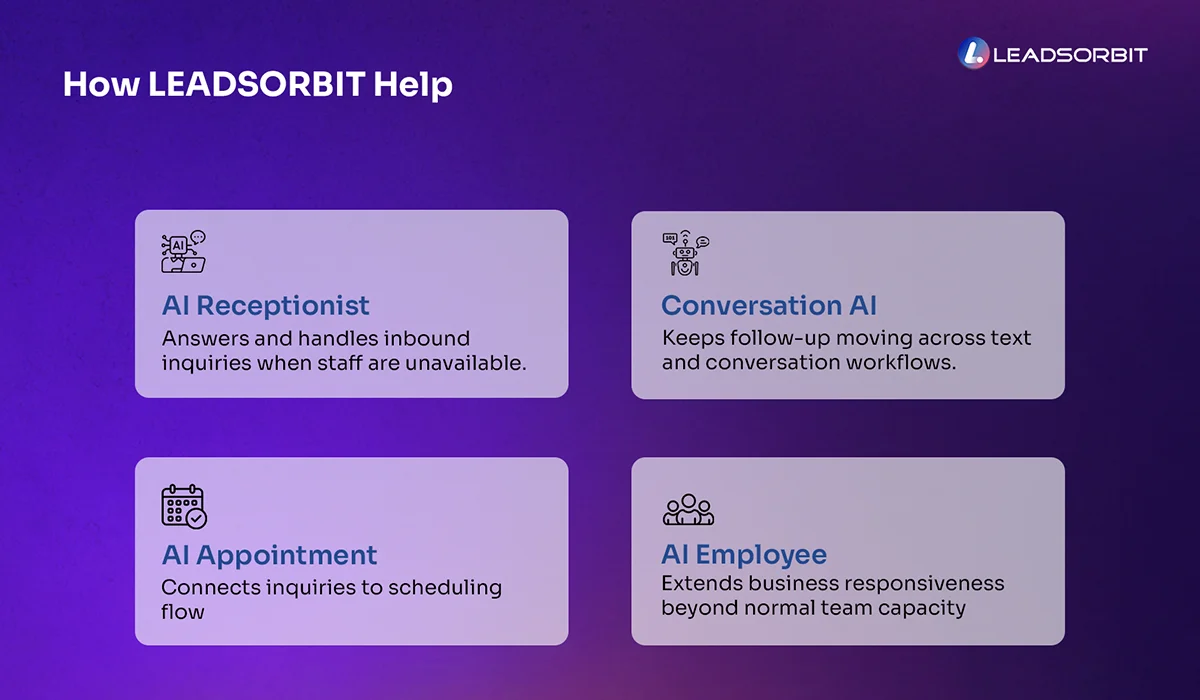
| LEADSORBIT feature | What it supports | Business outcome |
|---|---|---|
| AI Receptionist | Answers and handles inbound inquiries when staff are unavailable | Fewer lost leads from missed calls |
| Conversation AI | Keeps follow up moving across text and conversation workflows | Faster, more consistent response |
| AI Appointment | Connects inquiries to scheduling flow | More booked appointments |
| AI Employee | Extends business responsiveness beyond normal team capacity | Better 24/7 lead capture |
This is not limited to one niche. It applies across local and appointment driven industries, including:
- Chiropractic Software
- Physical Therapy Software
- Acupuncture Software
- Medical Spa Software
- Pet Care CRM
- Pet Grooming Software
- HVAC Service Software
- Plumbing Software
The real value is not just automation. It is having a practical system that helps the team stay organized, responsive, and easier to trust from the customer’s point of view.
These Mistakes Are Killing Your Conversions
| # | Common mistake | The fix (do instead) |
|---|---|---|
| 1 | Treating missed calls like a small admin issue | Do instead: Treat every missed call as a lead event that needs a defined next step. |
| 2 | Sending a vague text that goes nowhere | Do instead: Acknowledge the missed call and include a clear reply or booking option. |
| 3 | Waiting too long to respond | Do instead: Use instant acknowledgment plus same day follow up rules. |
| 4 | Asking too many questions too early | Do instead: Capture only what is needed to move the lead forward. |
| 5 | Using voicemail as the whole after hours strategy | Do instead: Build a real after hours call handling process with intake and follow up. |
| 6 | Letting staff handle things from memory | Do instead: Give the team scripts, checklists, and a written SOP. |
| 7 | Keeping calls, texts, and scheduling disconnected | Do instead: Connect the conversation to booking and reminders. |
| 8 | Reviewing performance only when bookings drop | Do instead: Review missed calls, recovery, and call to booking rate weekly. |
| 9 | Improving booking but ignoring no shows | Do instead: Protect the calendar with reminders and rescheduling steps. |
| 10 | Buying software before defining the process | Do instead: Build the workflow first, then map the right tool to it. |
FAQs About LEADSORBIT’s AI Receptionists for Small Business
It is a system that helps your business answer, capture, and route inquiries when your staff cannot respond immediately. It can support missed call recovery, intake, follow up, and appointment booking.
Final Thoughts
Here is the practical takeaway:
- Missed calls are not just communication gaps, they are revenue leaks
- After hours inquiries need a real workflow, not just voicemail
- Missed call text back is one of the easiest recovery upgrades
- Better intake questions create better follow up
- Booking should be connected directly to the conversation
- Reminders help protect your calendar after the booking happens
- Weekly KPI review helps you improve the process instead of guessing
- The best system is the one your team can follow consistently
If you want to see how this could look inside your own business, start with the most practical step:

Start Your Free 14 Day Trial
Try LEADSORBIT and see how it captures missed calls, follows up instantly, and turns leads into booked appointments for your business.
Personal Message from Faisal Zulfiqar
Missed calls are one of the most overlooked growth leaks in small business. The good news is you do not need complicated tech to fix it. You need a simple, consistent system your team will actually follow.
If you want help mapping this to your exact workflow, we can build a practical mockup using your intake questions, booking flow, and follow up steps.