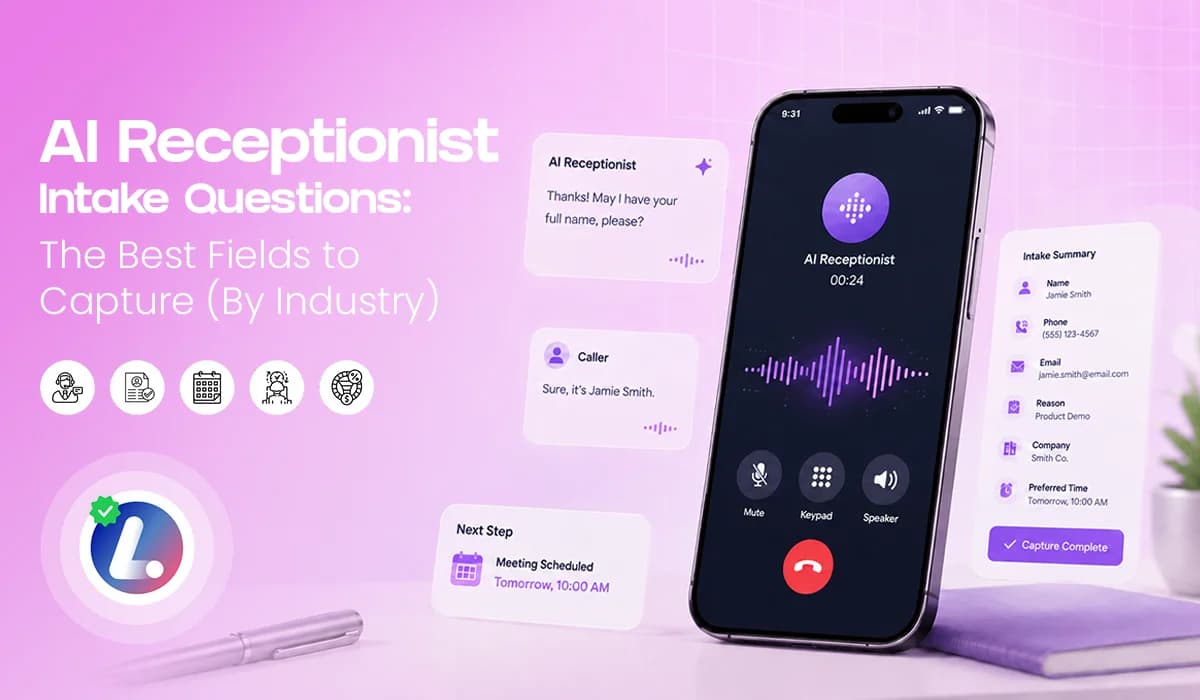

A lot of businesses think the hard part is answering the phone. In reality, one of the biggest conversion problems happens right after that: the wrong questions get asked, key details get missed, and the team has to start over later. That is why ai receptionist intake questions matter. The right intake flow helps your business capture useful lead details, qualify the inquiry, and move the caller toward the next step without creating friction.
This is not only true for AI receptionists. It is a broader lead handling principle. HubSpot’s sales qualification guidance shows that the right qualifying questions help you identify which prospects are worth pursuing and what information matters for the next stage. Calendly’s help docs also show that booking systems can collect extra details beyond just name and email, while routing forms can use those answers to direct people to the right destination.
In this guide, I will break down the best fields to capture, how to decide what your AI receptionist should ask, how those questions change by industry, and how to avoid making the intake flow too long or too weak.
Why Good Intake Questions Matter
When a lead calls, the business usually needs a few practical things:
- Who the caller is
- What they need
- Whether they are a fit
- How urgent the issue is
- What the next step should be
If those details are not collected properly, the business ends up with:
- Incomplete lead records
- Slower follow up
- Repeated questioning
- Weaker booking flow
- More drop off before the next step
That is why intake is not just a front desk formality. It is part of conversion.
Calendly’s help documentation says invitee questions can capture more than just basic contact details, and their routing forms are designed to direct visitors to the right person or destination based on their responses. That is a useful model for AI receptionists too: collect only what helps route, qualify, or book more accurately.
What AI Receptionist Intake Questions Should Actually Do
Before writing any questions, define the job.
A good intake flow should help your AI receptionist:
- Identify the caller’s need
- Collect the minimum useful details
- Decide the right next step
- Route the lead correctly
- Support booking if appropriate
- Reduce the need for your team to repeat basic questions
That means good intake questions should be:
- Short
- Relevant
- Easy to answer
- Tied to a real workflow
- Useful for someone on your team later
They should not feel like a long form being read out loud.
If you want the broader context for where intake fits, see AI Receptionist for Small Business.
The Core Fields Most Small Businesses Should Capture
Most businesses do not need twenty questions. They need the right few. Here are the core intake fields that matter most.
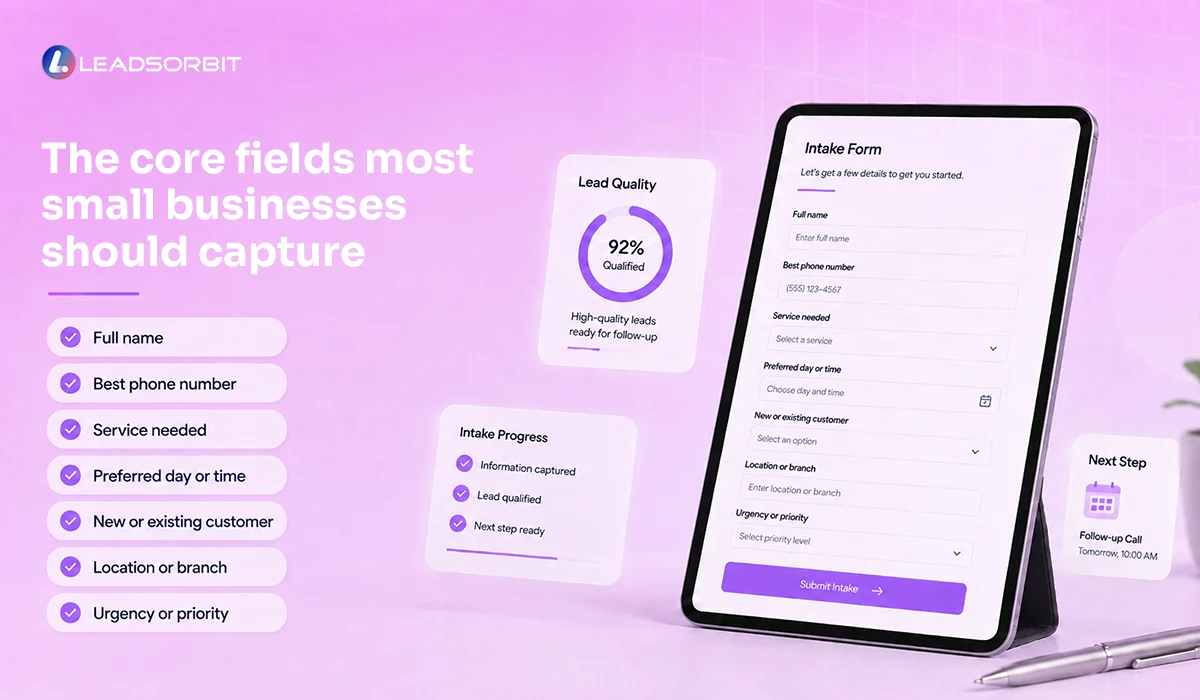
1. Full Name
This sounds obvious, but it matters because everything else gets harder without it. You need the caller’s name for:
- Conversation continuity
- Follow up
- Booking
- Note taking
- A more personal experience
2. Best Phone Number
Even if the person called in, you should still confirm the best callback number when needed. This helps when:
- The call drops
- The team needs to call back later
- The inquiry moves into follow up
- The lead books but needs reminders
3. Service Needed
This is one of the most important fields in the whole intake flow. You need to know:
- What the person wants
- Whether you actually offer it
- How to route the inquiry
- Which team member or workflow should own it
This is where a lot of businesses stay too vague.
4. Preferred Day Or Time
If the lead is booking oriented, this helps move faster. It also helps your team decide:
- Whether this is urgent
- Whether same day availability matters
- Whether the inquiry should go to scheduling next
5. New Or Existing Customer
This can change the path completely.
A new lead may need:
- Service qualification
- More education
- Intake questions
- Pricing explanation
An existing customer may need:
- Rebooking
- Support
- Rescheduling
- A quicker handoff
6. Location Or Branch
If the business has multiple locations or service areas, this becomes essential. It helps with:
- Call routing
- Eligibility
- Travel or service coverage
- Correct scheduling
7. Urgency Or Priority
Some businesses need this more than others, but when it matters, it matters a lot. This is especially useful for:
- Home services
- Urgent appointment requests
- Same day service businesses
- Businesses with limited capacity
8. Notes That Affect the Next Step
This should stay short, but it can be helpful when there is something important the team should know before the follow up or booking.
How to Choose the Right Lead Qualification Questions
This is where many businesses either ask too much or too little. HubSpot’s qualification guidance is useful here because it frames qualification around what helps determine fit, urgency, value, and next step, rather than asking random questions just because the system can.
A practical rule is this: only ask a question if the answer changes what should happen next.
A good lead qualification question should help you decide:
- Is this a fit
- Is this urgent
- Who should handle it
- Can this person book now
- Does the team need more preparation first
How Many Intake Questions Are Too Many
This depends on the business, but the safest approach is to keep the first interaction light.
As a rule:
- Use fewer questions for cold leads
- Use a few more for booking ready leads
- Use deeper forms only when truly needed after booking or during follow up
Calendly’s invitee question guidance shows how booking systems add custom questions beyond name and email, but the goal is still practical detail collection, not long forms for their own sake.
A short intake flow usually performs better because it:
- Keeps the caller engaged
- Reduces friction
- Speeds up routing
- Makes the conversation feel easier
The Best Intake Questions by Industry
The right fields vary depending on what the business actually does.
Chiropractic and Clinic Based Businesses
For businesses like Chiropractic Software or Dental Software, the intake flow should support appointment readiness.
Useful questions:
- Are you a new or existing patient
- What type of issue or service are you calling about
- What day or time works best for you
- Do you have a preferred provider or location
- Is this for an urgent appointment or general scheduling
The goal is not full medical intake on the first call. It is enough detail to route or book correctly.
Medical Spas
For businesses like Medical Spa Software, callers are often deciding between consultation and direct service booking.
Useful questions:
- What service are you interested in
- Is this your first visit with us
- Are you looking to book a consultation or treatment
- What day or time works best
- Do you have any specific goals or concerns
That helps the team prepare without overwhelming the lead.
Pet Grooming
For businesses using Pet Grooming Software, the service details are usually very practical.
Useful questions:
- What type of service do you need
- What breed is your pet
- Is this your first visit
- What day works best for you
- Is there anything we should know before booking
This helps route the lead into the right appointment flow quickly.
Home Services
For service businesses, the first job is often triage.
Useful questions:
- What service do you need
- What zip code or service area are you in
- Is this urgent
- Are you a new or existing customer
- What is the best callback time
These questions help prioritize and route efficiently.
A Simple Receptionist Intake Checklist You Can Use
Here is a clean version most businesses can start with.
Core Intake Checklist
Use these fields as your first version:
- Full name
- Best callback number
- Service needed
- New or existing customer
- Preferred day or time
- Location or branch if relevant
- Urgency if relevant
- Short notes for the next step
If the Business Is Appointment Driven, Add:
- Booking intent
- Provider preference
- Service category
If the Business Is Service Area Based, Add:
- Zip code
- Urgency
- Call back timing
A Simple Intake Script Your AI Receptionist Can Follow
Here is a usable structure.
General Intake Script

Then continue with:
- Are you a new or existing customer?
- What day or time works best for you?
- Is there anything important we should know before the next step?
Booking Focused Version
Service Area Version
Try LEADSORBIT free for 14 days
How Booking Systems Reinforce Good Intake Design
This is where booking tools and AI receptionists overlap.
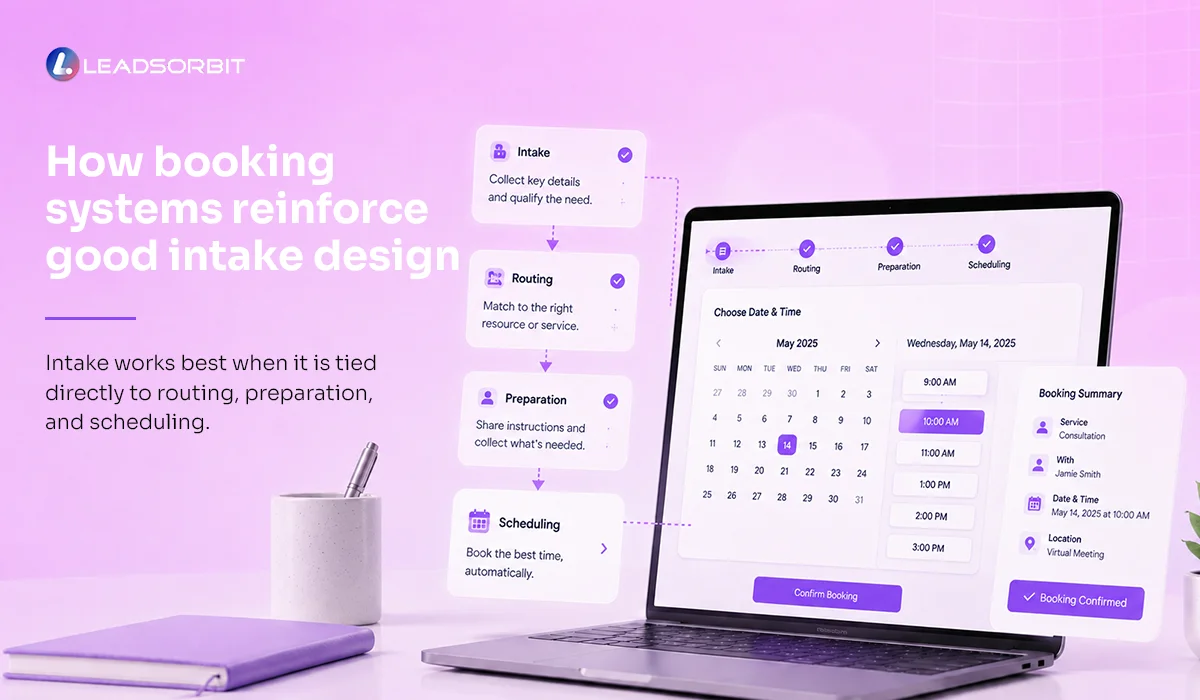
Calendly’s routing forms are built to gather visitor details and route them based on rules like industry, company size, or interests. Square also explains that appointment related digital forms can collect important client information and be tracked around the booking process. Those examples reinforce the same lesson: intake works best when it is tied directly to routing, preparation, and scheduling.
That is why AI Appointment matters in this workflow. Intake should not live in isolation. It should help the lead move cleanly toward a booking or next step.
If you need the broader explanation of how the system works, pair this with What Is an AI Receptionist for Small Business. If you want the clinic specific application, the next related post is AI Receptionist for Clinics.
Mistakes to Avoid When Building AI Receptionist Intake Questions
Asking too Many Questions Too Early
This is one of the easiest ways to create friction.
Asking Questions That Do Not Affect the Workflow
If the answer does not change routing, booking, or follow up, it may not need to be asked right away.
Forgetting to Capture Callback Details
A great conversation still fails if your team cannot reach the lead later.
Making the Intake Flow the Same for Every Industry
Different business models need different fields.
Treating Intake Like a Full Form Instead of a First Step Conversation
The goal is to move the lead forward, not collect every possible detail in one interaction.
What to Track After You Set Your Intake Flow
A good intake flow should be measured by quality, not just completion.
Intake Completion Rate
- Definition: The percentage of inquiries where the key fields are captured properly.
- What improvement looks like: More complete lead records and fewer missing details.
Routing Accuracy
- Definition: How often the intake answers lead to the right next step or handoff.
- What improvement looks like: Fewer wrong transfers and better lead flow.
Booking Conversion Rate
- Definition: The percentage of intakes that move into a booked appointment or qualified next step.
- What improvement looks like: Better conversion from inbound demand.
Repeat Question Reduction
- Definition: How often staff still have to ask the same basic questions later.
- What improvement looks like: Cleaner handoffs and less duplicated effort.
After Hours Capture Quality
- Definition: How well off hours inquiries still collect useful details.
- What improvement looks like: Better follow up the next business day.
How LEADSORBIT Helps You Capture Better Intake Details
The goal is not to build a long form. The goal is to capture the right details with the least friction.
Here is the practical mapping:
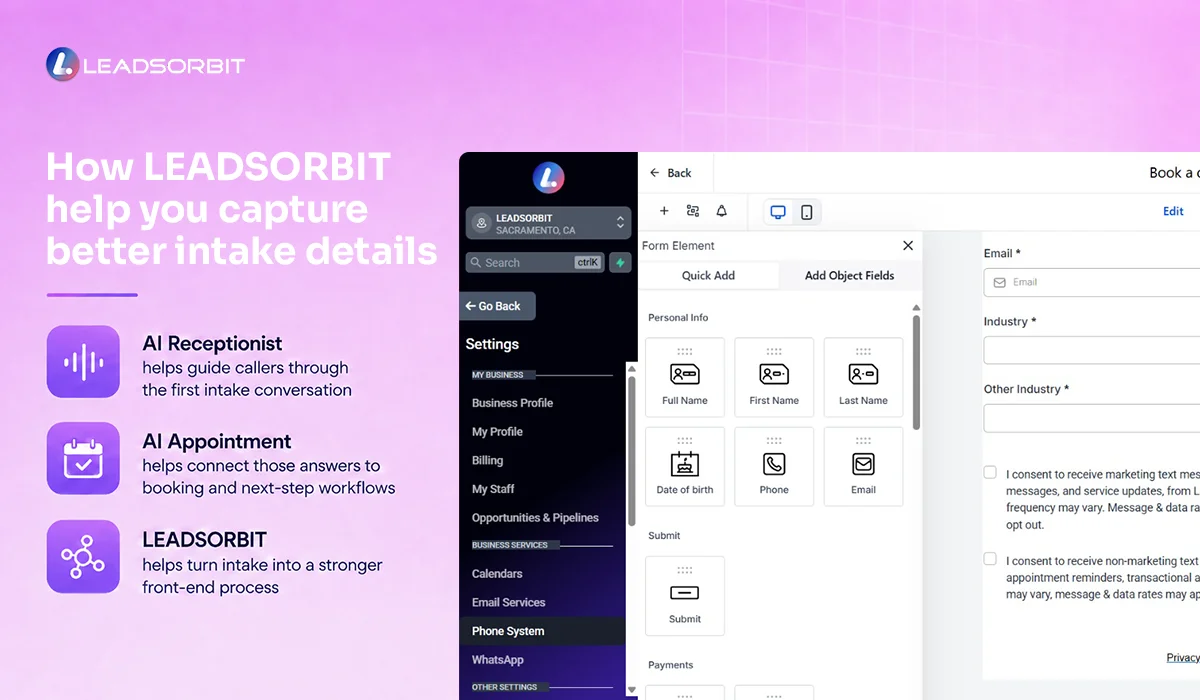
- AI Receptionist helps guide callers through the first intake conversation
- AI Appointment helps connect those answers to booking and next step workflows
- LEADSORBIT helps businesses turn intake from a weak handoff into a stronger front end process
- For industries like chiropractic, dental, med spa, and pet grooming, that means cleaner routing and less back and forth before booking
If you want to see how this could look for your own workflow, the next practical step is to Book a Demo. If you prefer, you can also get a Free Mockup.
FAQs
They are the questions your AI receptionist asks to capture the basic details needed to qualify, route, or book a caller correctly.
Final Thoughts
Here are the main takeaways:
- Intake questions shape lead quality more than most businesses realize.
- The best intake flow asks only what affects the next step.
- Most businesses need fewer questions, not more.
- The right fields vary by industry and workflow.
- Booking and routing should be tied directly to intake answers.
- A short, practical intake structure usually performs better than a long one.
- Strong intake reduces repeated questions and improves handoff quality.
Start Your Free 14 Day Trial
Try LEADSORBIT and see how it captures missed calls, follows up instantly, and turns leads into booked appointments for your business.
Personal Message from Faisal Zulfiqar
A lot of businesses lose momentum right at the start of the conversation.
Not because the lead was weak, but because the intake flow was unclear.
The team asked too much, asked the wrong things, or forgot to capture what actually mattered.
That is why I believe intake should feel simple, purposeful, and easy for the caller.
LEADSORBIT is built to support that kind of practical workflow.
Not a long form, not unnecessary friction, just the right questions that help the business move forward faster.
And when the first interaction is cleaner, the rest of the process usually becomes much easier too.
That is where better follow up and better bookings usually begin.