
A lot of small businesses lose good leads after closing time without even realizing how often it happens. The phone rings after hours, nobody answers, the caller hears voicemail, and that is the end of the interaction. That is why after hours call handling for small business matters so much. If the business does not have a clear system for what happens after close, it is easy to lose inquiries that were still ready to book, ask questions, or request service.
Business phone platforms already treat this as a core workflow issue. RingCentral’s answering rules documentation says businesses can set custom days and hours, route off hours calls to voicemail or another number, and play different greetings based on schedules. Twilio’s time of day routing guide also shows how a business can respond differently depending on whether a call comes in during open or closed hours.
In this guide, I’ll walk through the best practices, SOPs, scripts, and metrics that make after hours phone answering more reliable using LEADSORBIT, without making your team’s life harder.
Why After Hours Call Handling Matters for Small Business
When someone calls after business hours, they usually want one of a few things:
- To know whether you can help
- To ask about service availability
- To leave details for a callback
- To book the next step
- To get help with something urgent
If the only experience they get is a generic voicemail, the business is putting too much pressure on the caller to stay interested. That is where after hours call handling becomes a real business issue, not just a phone issue.
A better after hours workflow helps you:
- Acknowledge the caller
- Guide them to the right next step
- Separate urgent from non urgent needs
- Capture the details your team needs
- Reduce the chance that the lead goes cold overnight
Twilio’s time of day routing example is built around exactly this idea: Callers should receive one experience during open hours and a different response outside business hours.
Why Many Small Businesses Still Struggle After Closing Time
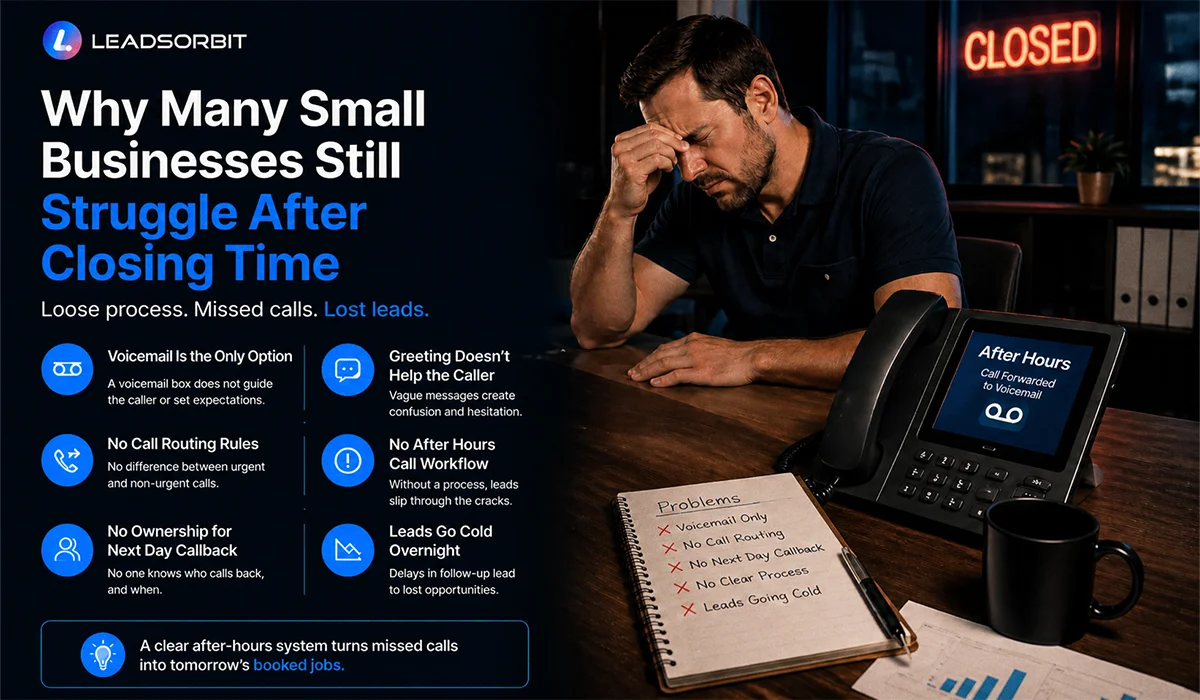
Most teams do not fail here because they do not care. They fail because the process is too loose.
1. Voicemail Becomes the Whole Strategy
A voicemail box is not the same as an after hours answering service.
A real system should do more than record a message. It should give callers:
- Clear expectations
- Useful next steps
- A path to share the right information
- A way to feel heard even when the office is closed
2. There is no Difference Between Urgent and Non Urgent Calls
Some after hours calls can wait until morning. Some need faster routing.
If the business does not define that difference, then:
- Urgent calls may sit too long
- Non urgent calls may create confusion
- Staff may get interrupted unnecessarily
- Callers may not know what to do
3. No One Owns the Next Day Callback Process
- Many businesses say, “We’ll return the call tomorrow.”
- But who will? At what time? Based on what priority? Using what script?
- If ownership is vague, follow up becomes inconsistent.
4. The Greeting Does Not Help the Caller Move Forward
A weak greeting sounds like:
- “We’re closed. Leave a message.”
A better greeting helps the caller understand:
- Whether the business is closed
- What to do next
- What details to leave
- When to expect a follow up
RingCentral’s answering rules documentation specifically notes that businesses can schedule unique greetings and route calls differently during off hours, holidays, or special events.
How to Build a Better After Hours Call Workflow
You do not need a huge system. You need a clean one.
1. Start With Clear Business Hours Rules
The first step is simple.
Define when your business is open and when it is closed.
That sounds obvious, but many businesses never formally set:
- Weekday hours
- Weekend hours
- Holiday rules
- Special schedule changes
RingCentral says businesses can customize days and hours of operation and create separate business hours and after hours answering rules. That matters because your after hours system cannot work properly if the business hours logic is unclear.
2. Decide What Should Happen After Hours
For most small businesses, after hours call routing should answer a few questions:
- Should the caller hear a greeting first?
- Should the call route to voicemail?
- Should the call forward to an alternate number?
- Should only certain callers or urgent categories be allowed through?
- Should the system send a follow up text or ask for the next day?
RingCentral’s documentation says after hours rules can route calls directly to voicemail, another number, or other destinations, and can also allow certain contacts through during off hours while others are sent elsewhere.
That gives you a useful framework:
Not every caller needs the same after hours path.
3. Separate Urgent From Non Urgent Calls
This is especially important for businesses like:
- HVAC
- Plumbing
- Home services
- Clinics with urgent appointment questions
A basic after hours call workflow should decide:
- Which calls are emergencies or priority issues?
- Which calls should wait for next day callback?
- Which calls can be handled by an automated message plus intake?
If your business fits a service category with time sensitive calls, your HVAC Service Software or Plumbing Software workflow should reflect that clearly.
4. Make the Caller Experience Simple
A good after hours system should feel helpful, not complicated.
The caller should quickly understand:
- That they reached the right business
- That the office is currently closed
- What information to leave
- Whether urgent help is available
- When they will hear back
Twilio’s example for time of day routing shows a simple closed hours response as a practical first layer for after hours logic.
Build a Next Day Callback System Behind the Greeting
This part is where many businesses fail. Even a good greeting will not help much if there is no strong morning follow up process.
Your team should know:
- Where after hours calls appear?
- What details were captured?
- Which leads are highest priority?
- Who is responsible for callback?
- How quickly callback should happen?
If your broader issue is slow follow up overall, pair this with Lead Response Time for Small Business.
After Hours Call Handling SOP for Small Business
Here is a practical version you can follow.
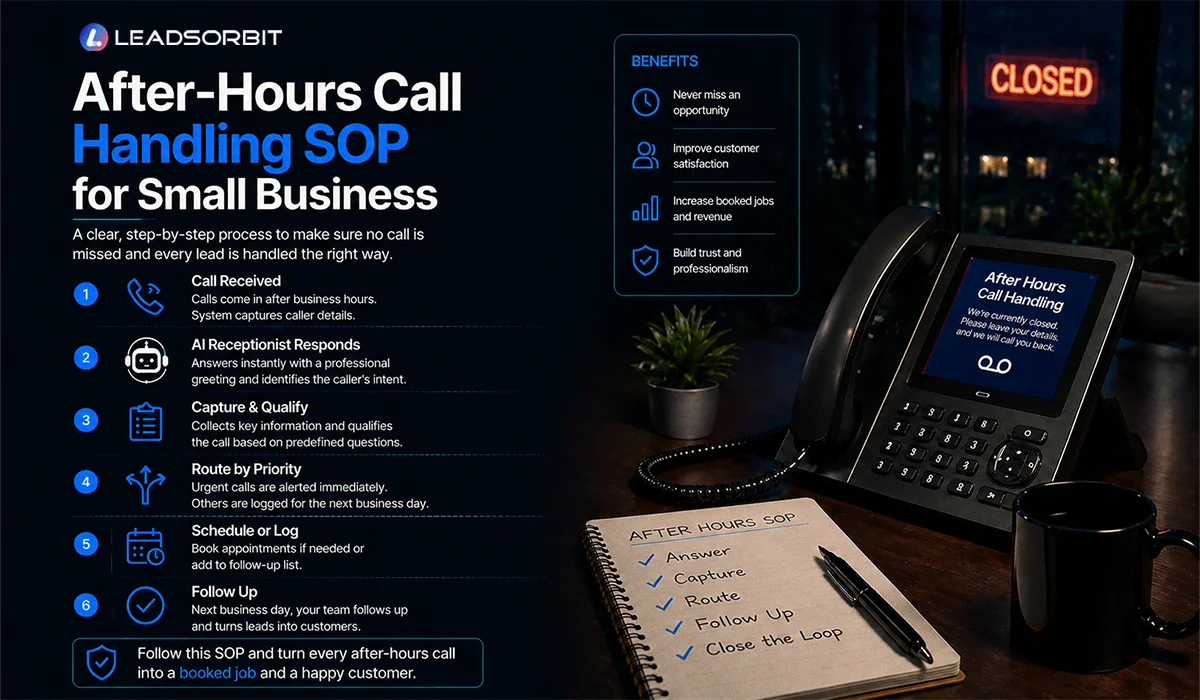
Step 1
Define your official business hours and off hours schedule.
Step 2: Set different call routing rules for:
- Business hours
- After hours
- Weekends
- Holidays
Step 3: Choose the after hours destination:
- Voicemail
- Alternate number
- Call queue
- Automated message flow
Step 4: Create two caller paths:
- Urgent or priority
- Normal next day follow up
Step 5: Use a greeting that tells the caller:
- You are closed
- What to do next
- What to leave
- When they will hear back
Step 6: Capture the right intake details:
- Name
- Number
- Service need
- Urgency
- Preferred callback time
- Location if relevant
Step 7: Create a next business day callback list and assign ownership.
Step 8: Review after hours calls first thing every morning.
Step 9: Track what happened:
- Callback completed
- Booked
- No answer
- Follow up needed
This is where Workflow AI becomes helpful. The greeting is not the whole system. The workflow behind it is what makes after hours lead capture actually work.
Scripts for After Hours Phone Answering
1. Basic After Hours Greeting

2. Booking Focused After Hours Greeting
3. Urgent vs Non Urgent Greeting
4. Next Day Callback Script
Then ask:
- What were you calling about
- Is this still urgent
- Are you looking to book or ask a question
- What is the best next step for you
Try LEADSORBIT free for 14 days
A Simple After Hours Checklist for Your Team
Use this checklist to keep the system consistent.
Daily After Hours Checklist
- Review all after hours calls first thing in the morning
- Separate urgent callbacks from standard callbacks
- Check whether each caller left enough intake detail
- Call back high priority leads first
- Update lead status after each callback
- Move qualified leads into booking or next step workflow
- Review whether any after hours calls were routed incorrectly
What to Track in Your After Hours Call Handling Process
You do not need a huge dashboard, but you do need a few useful numbers.
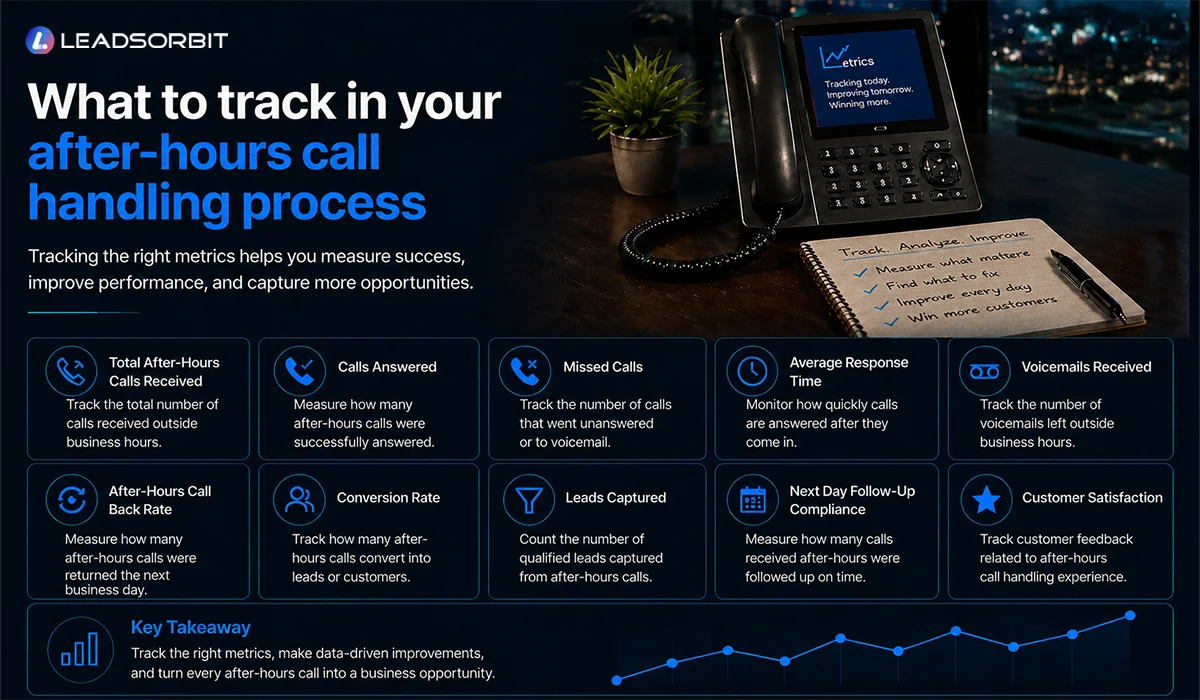
After Hours Call Volume
Definition: The number of calls that come in outside your normal operating hours
What improvement looks like: Better visibility into when off hours demand is happening.
After Hours Capture Rate
Definition: The percentage of after hours calls that enter your workflow properly.
What improvement looks like: Fewer calls disappearing into missed or unclear follow up.
Next Day Callback Completion Rate
Definition: The percentage of after hours callers who receive the promised callback.
What improvement looks like: More reliable follow up and less lead leakage.
After Hours Call to Booking Rate
Definition: The percentage of after hours callers who move into a booked or qualified next step.
What improvement looks like: Better conversion from off hours demand.
Response Time to After Hours Calls
Definition: How quickly the business follows up after reopening.
What improvement looks like: Faster first callback and better prioritization.
How LEADSORBIT Helps With After Hours Lead Handling
The biggest mistake in after hours call handling is thinking only about the greeting. The real value is in the full workflow.
Here is the practical mapping:
- AI Receptionist helps give callers a better off hours experience instead of leaving them at a dead end
- Workflow AI helps route after hours inquiries into structured next day follow up
- For businesses with time sensitive demand, especially in home services, that can reduce overnight lead leakage
- If cost is part of your evaluation, connect this with Cost of an AI Receptionist for Small Business
If you want to see how your after hours flow could look with a cleaner setup, a Book a Demo is often the easiest next step.
FAQs
It is the system a business uses to manage inbound calls outside normal operating hours, including greetings, routing, voicemail, follow up, and next day callback rules.
Final Thoughts
Here are the main takeaways:
- After hours call handling should be treated as part of lead capture, not just phone admin
- Voicemail alone is rarely a complete strategy
- Business hours and after hours rules should be clearly separated
- Callers need a simple message with a clear next step
- Urgent and non urgent inquiries should not follow the same path
- Next day callback ownership matters just as much as the greeting
- A better after hours workflow can protect leads you would otherwise lose overnight

Start Your Free 14 Day Trial
Try LEADSORBIT and see how it captures missed calls, follows up instantly, and turns leads into booked appointments for your business.
Personal Message from Faisal Zulfiqar
A lot of businesses work hard all day and still lose opportunities after they close.
Not because demand was weak, but because the process after hours was never clearly built.
That is why I believe after hours handling should be simple, intentional, and easy for the team to follow.
It does not need to feel complicated.
It just needs to make the caller feel guided and make the next morning easier for your staff.
LEADSORBIT is built to support that kind of practical workflow, especially for small businesses where every good lead matters.
If we can help you reduce overnight leakage and create a cleaner follow up process, that is real progress.
And for many businesses, that progress shows up faster than expected.