
When a new lead reaches out, interest is usually at its highest in that moment. That is why lead response time for small business matters so much. The longer a business waits, the more that initial intent starts to fade. InsideSales summarizes this clearly in its 2021 lead response research: conversion rates were more than 8x higher when the first attempt happened within 5 minutes, compared with waiting longer than 5 minutes.
This does not mean every small business can respond perfectly to every inquiry every time. But it does mean speed to lead is not a “nice to have.” It is part of lead conversion. In this guide, I’ll break down why fast follow up matters, what slows small businesses down, how to respond to LEADSORBIT fast with a practical workflow, what templates to use, and which KPIs to track so you can improve without creating chaos for your team.
Why Lead Response Time Matters More Than Most Small Businesses Think
A lot of businesses assume that if a lead is serious, they will wait.
Sometimes they do. Many times they do not.
When someone fills out a form, calls your business, or asks for information, they are often:
- Actively comparing options
- Trying to book now
- Checking whether you are responsive
- Deciding who feels easiest to work with
That is why response timing has such a strong effect on outcomes. The Lead Response Management Study says the likelihood of successfully contacting and qualifying a lead drops sharply after the first hour, and its 5 minute analysis highlights a dramatic drop between very fast follow up and waiting 30 minutes.
For a small business, this shows up in familiar ways:
- More leads go cold
- More follow up effort is needed later
- Fewer inquiries turn into bookings
- Marketing spend feels less efficient
- Staff feel busy but results still feel inconsistent
So when owners talk about not getting enough leads, part of the problem is sometimes not volume. It is a response delay.
Why So Many Small Businesses Still Respond Too Slowly
This is usually not a motivation issue. It is a workflow issue.
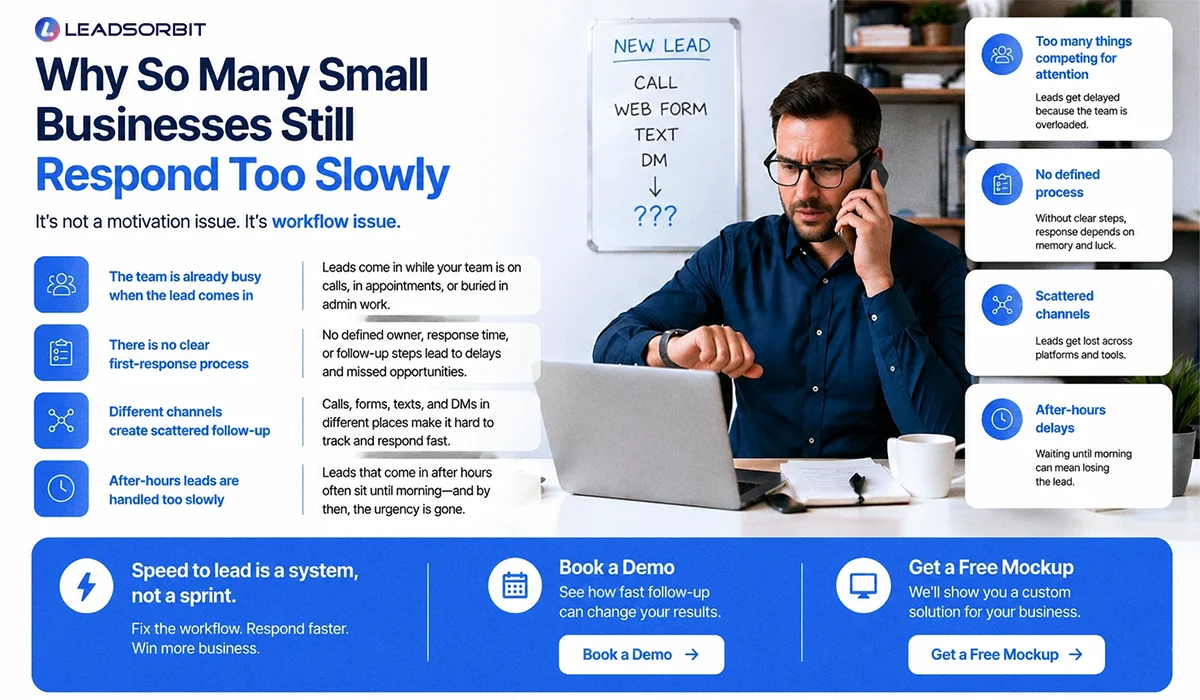
1. The Team Is Already Busy When The Lead Comes In
Front desk staff, office managers, sales staff, and owners are often doing too many things at once.
A new lead comes in while someone is:
- Helping a current customer
- In an appointment
- On another call
- Driving between jobs
- Dealing with admin work
So even good teams respond late simply because they are overloaded.
2. There Is No Clear First Response Process
If nobody has defined:
- Who gets the lead
- How fast they should respond
- What the first message should say
- What happens if the lead does not answer
then response speed depends on memory and availability.
3. Different Channels Create Scattered Follow Up
One lead may call. Another may fill out a form. Another may send a text or DM.
If those channels are disconnected, the team loses time figuring out:
- Where the lead came from
- Whether someone already responded
- What the next step should be
4. After Hours Leads Are Handled Too Slowly
A lead that comes in after hours often sits until the next morning, which turns a warm opportunity into a colder one. The Lead Response Management Study found that timing matters not only by day and time block, but especially by how quickly the first response happens after the lead is created.
5. Owners Do Not Always Measure Response Time Directly
Most teams can tell you how many leads came in. Fewer can tell you:
- How fast the first response went out
- How many leads waited too long
- How many leads were never contacted
- How many leads were touched within 5 minutes
InsideSales reported that in its 2021 research, less than 1% of attempts happened within 5 minutes, and 57.1% of all attempts waited longer than a week.
Why 5 Minutes Wins When Speed To Lead Matters
InsideSales says its 2021 research found conversions were more than 8x higher when a first attempt happened inside 5 minutes versus after 5 minutes. Older Lead Response Management research also found dramatically higher odds of contact and qualification when leads were called back within 5 minutes instead of waiting 30 minutes.
The “5 minute rule” is popular for a reason. It is not random. For a small business, that does not mean a live human must always jump in instantly. It means the business should have a fast first response system.
That first response can be:
- A quick text
- A call back attempt
- An automated acknowledgment
- A lead routing workflow
- A booking path
- A short after hours message with next steps
The key idea is simple:
A fast first response keeps the conversation alive.
That is what gives you a better chance to turn interest into action.
How To Improve Lead Response Time Without Overwhelming Your Team
You do not need a giant sales team to improve follow up speed. You need a simpler process.
1. Start By Setting One Clear Response Goal
The easiest first step is to define your internal standard.
For example:
- New call or form lead gets first response within 5 minutes when possible
- After hours lead gets immediate acknowledgment and next business day human follow up
- Missed calls get instant text back
- No lead should sit unassigned
Even if you cannot hit the ideal every time, having a target improves consistency.
2. Separate First Response From Full Follow Up
A lot of teams respond slowly because they think the first response has to do everything.
It does not.
Your first response only needs to do a few things:
- Confirm the lead was received
- Open the conversation
- Reduce uncertainty
- Point toward the next step
That is much easier than trying to fully qualify and book in one touch.
3. Use Automation For The Fastest First Step
This is where Workflow AI can help.
A good workflow can:
- Route the lead quickly
- Send an immediate acknowledgment
- Create a task
- Assign ownership
- Trigger the next follow up step
That reduces the burden on staff without slowing the customer experience.
4. Keep Your Follow Up Messages Short And Clear
Fast follow up is easier when the team is not writing custom responses every time.
Use:
- One first response template for calls
- One for forms
- One for after hours inquiries
- One for no answer follow up
That improves both speed and consistency.
5. Build A Simple Callback Window
For phone based leads, define a practical callback rule.
For example:
- First callback within 5–10 minutes when possible
- Second touch within the same business day
- After hours callback first thing next morning
This helps your team act faster because they are not guessing what “soon” means.
6. Review Where The Delays Happen
Ask:
- Are leads sitting unassigned
- Are missed calls not getting a text back
- Are replies waiting too long in the inbox
- Are after hours inquiries piling up overnight
- Are multiple tools slowing the handoff
That tells you where your response process is breaking.
If missed calls are a big part of your delay problem, connect this post with How Missed Calls Are Costing Small Businesses Revenue. If after hours response is the bigger issue, your next read should be After Hours Call Handling Best Practices for Small Business.
Smart Lead Response Workflow For Small Business
Here is a simple structure that works well in practice.
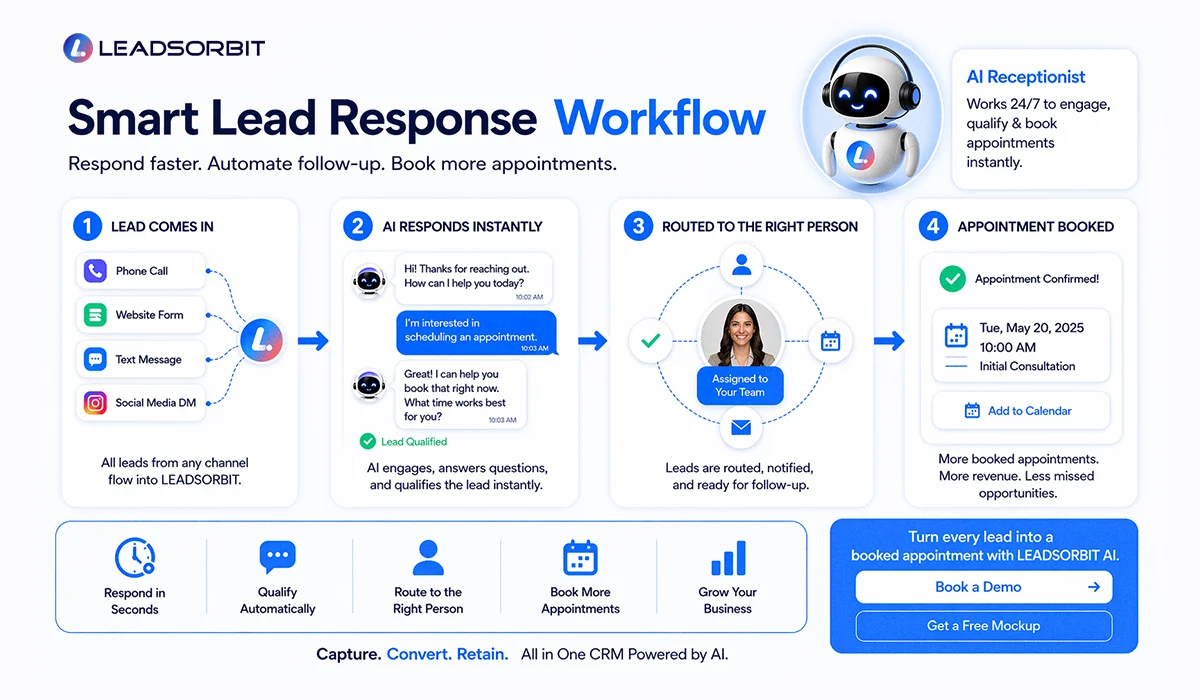
Step 1
Lead comes in by call, form, text, or message
Step 2
Immediate first response goes out
- Live response if available
- Otherwise automated acknowledgment or missed call text
Step 3
Lead is assigned to the right person or workflow
Step 4
A human follow up happens inside the defined callback window
Step 5
The lead is moved to the next step
- Booked
- Quoted
- Qualified
- Follow up needed
- No Response
Step 6
The status is updated so the team can see what happened.
This is where Conversation AI becomes valuable. It helps keep the response moving instead of letting conversations disappear across disconnected tools.
If you want to see how a faster lead flow might look in your own business, a Free Mockup is often the easiest way to make the gaps visible.
Lead Response Templates You Can Actually Use
First Response For A New Inbound Lead

Missed Call Follow Up Text
After Hours Response
Callback Script
Then ask:
- What were you looking for help with
- Are you ready to book or still comparing options
- What is the best next step for you
Try LEADSORBIT free for 14 days
What To Track If You Want Faster Follow Up
You cannot improve what you do not measure.
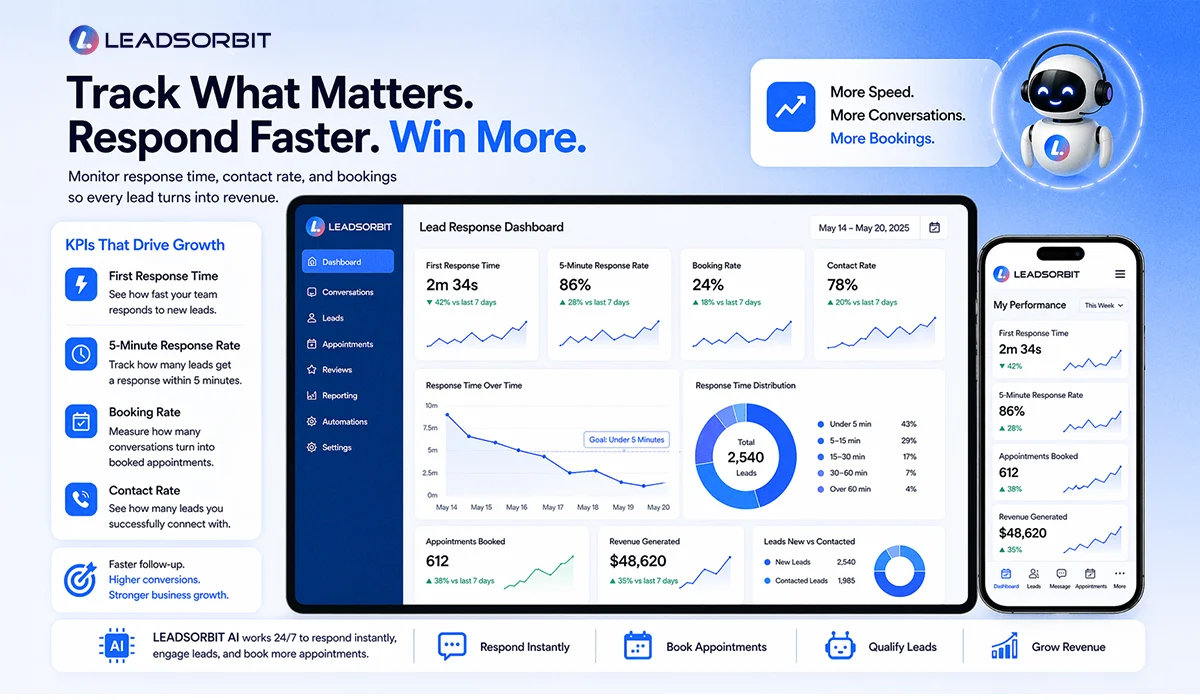
First Response Time
Definition: How long it takes for the lead to get the first reply after reaching out.
What improvement looks like: A lower average response time and more leads receiving a fast first touch.
Five Minute Response Rate
Definition: The percentage of leads that get a first response within 5 minutes.
What improvement looks like: More leads getting that fast early engagement window.
Contact Rate
Definition: The percentage of leads that turn into a real two way conversation.
What improvement looks like: More leads actually engaging after first response.
Call To Booking Or Lead To Booking Rate
Definition: The percentage of leads that become booked appointments or qualified next steps.
What improvement looks like: Faster response translating into more conversion.
After Hours Capture Rate
Definition: The percentage of after hours leads that still get acknowledged and followed up properly.
What improvement looks like: Fewer overnight leads going cold.
How LEADSORBIT Helps Small Businesses Respond Faster
The goal is not to chase speed for the sake of speed.
The goal is to create faster, cleaner lead handling.
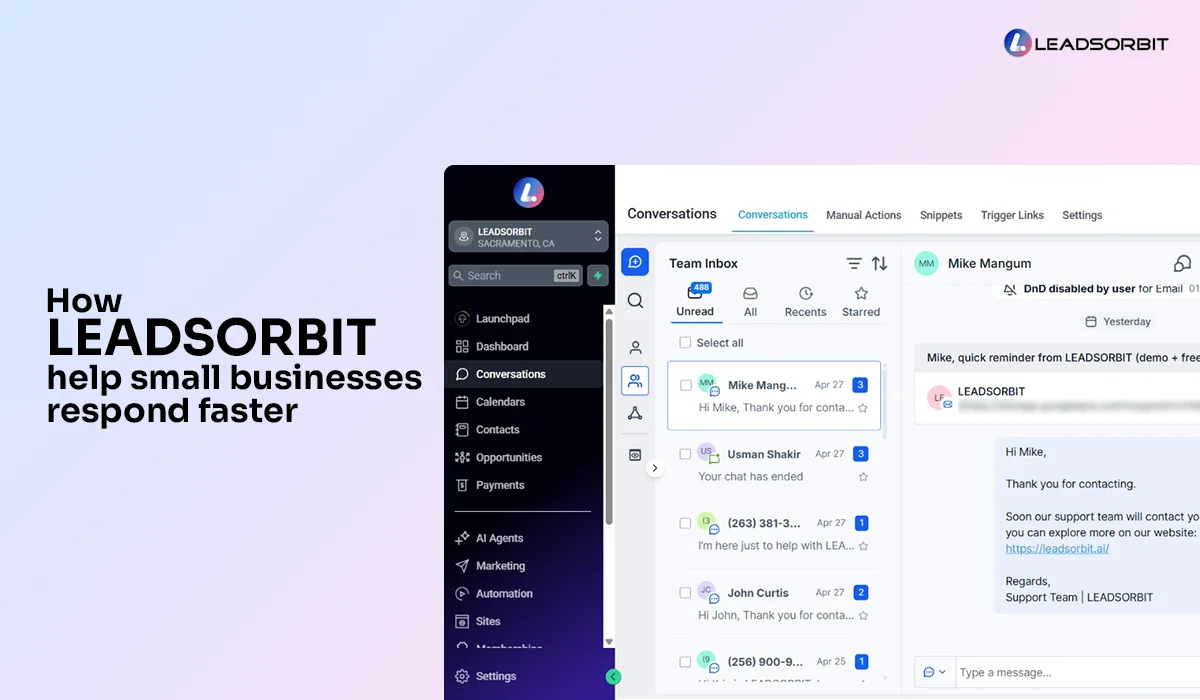
Here is the practical mapping:
- Conversation AI helps keep follow up active and visible after the first touch
- Workflow AI helps route leads, trigger responses, and reduce response delay
- Businesses in categories like Chiropractic Software and Medical Spa Software often benefit because fast answers and appointment flow matter a lot in those categories
- LEADSORBIT is built to reduce the gaps between inquiry, response, and booking
That is how better lead response time turns into better business outcomes.
FAQs
The strongest benchmark is to respond within 5 minutes when possible. Research from InsideSales and earlier lead response studies consistently highlights the sharp drop in effectiveness after that window.
Final Thoughts
Here are the main takeaways:
- Lead response time is a conversion issue, not just a communication issue.
- The first 5 minutes matter because lead interest is highest right away.
- Small businesses often respond slowly because workflows are unclear, not because they do not care.
- A fast first response does not have to do everything.
- Automation can help protect speed to lead without overwhelming the team.
- The right KPIs help you improve response timing instead of guessing.
- Better response speed can help you recover more value from the leads you already have.

Start Your Free 14 Day Trial
Try LEADSORBIT and see how it captures missed calls, follows up instantly, and turns leads into booked appointments for your business.
Personal Message from Faisal Zulfiqar
A lot of businesses lose good leads without realizing the real issue was timing.
Not because the offer was weak.
Not because the market was bad.
But because the follow up came too late.
That is why I believe response speed should be treated as part of the sales process, not just admin work.
LEADSORBIT is built to help small businesses respond in a more practical and organized way, especially when teams are already stretched.
You do not need a perfect system overnight.
You just need a better one than the lead went into yesterday.
And when response gets faster and cleaner, better bookings usually follow.