
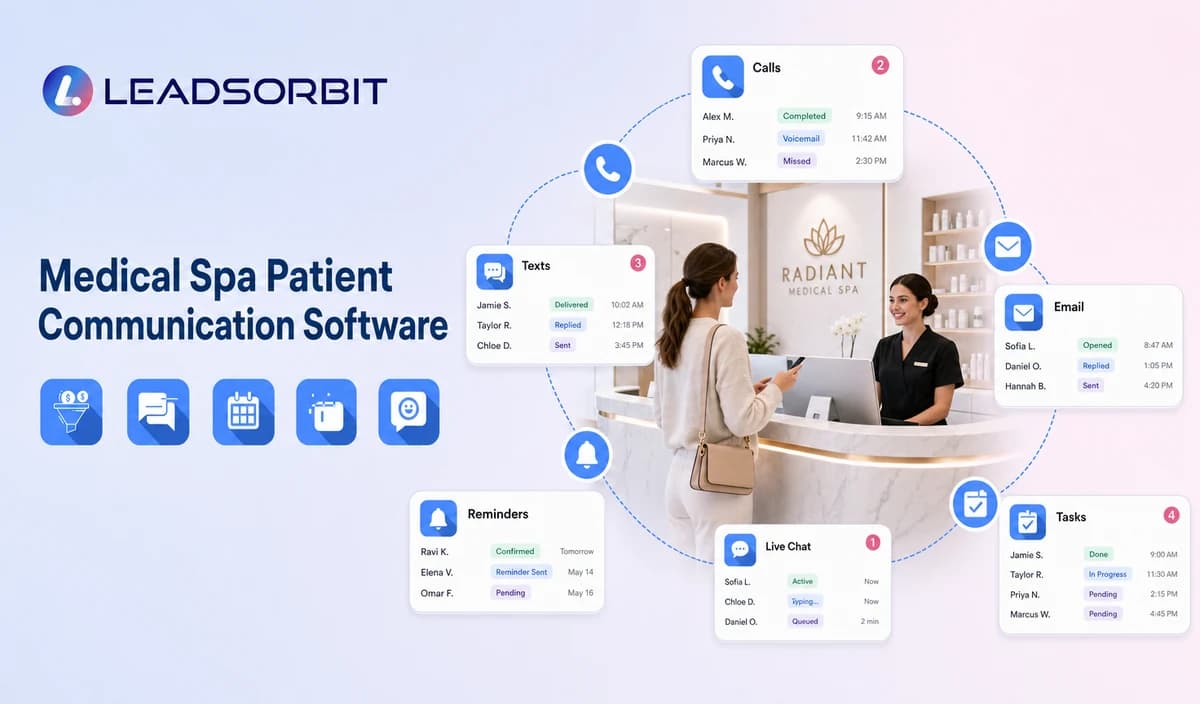

Medical spa communication may happen through phone calls, SMS, email, web chat, forms, social messages, appointment reminders, and staff callbacks. When those conversations live in separate tools, the patient repeats information and the team loses the next action.
Medical spa patient communication software should connect administrative conversations, consultation booking, and staff tasks without pretending to be a medical record, treatment platform, photo/consent system, membership system, or payment platform. The broader CRM owner remains small business CRM.

Who This Guide Is For
- Medical spas using separate tools for calls, texting, email, forms, chat, and reminders.
- Front desk teams that ask patients to repeat the same administrative request.
- Practice managers who need clear ownership across channels.
- Multi location practices that need location aware routing and staff handoffs.
- Healthcare organizations evaluating HIPAA enabled communication workflows.
What Communication Software Should Connect
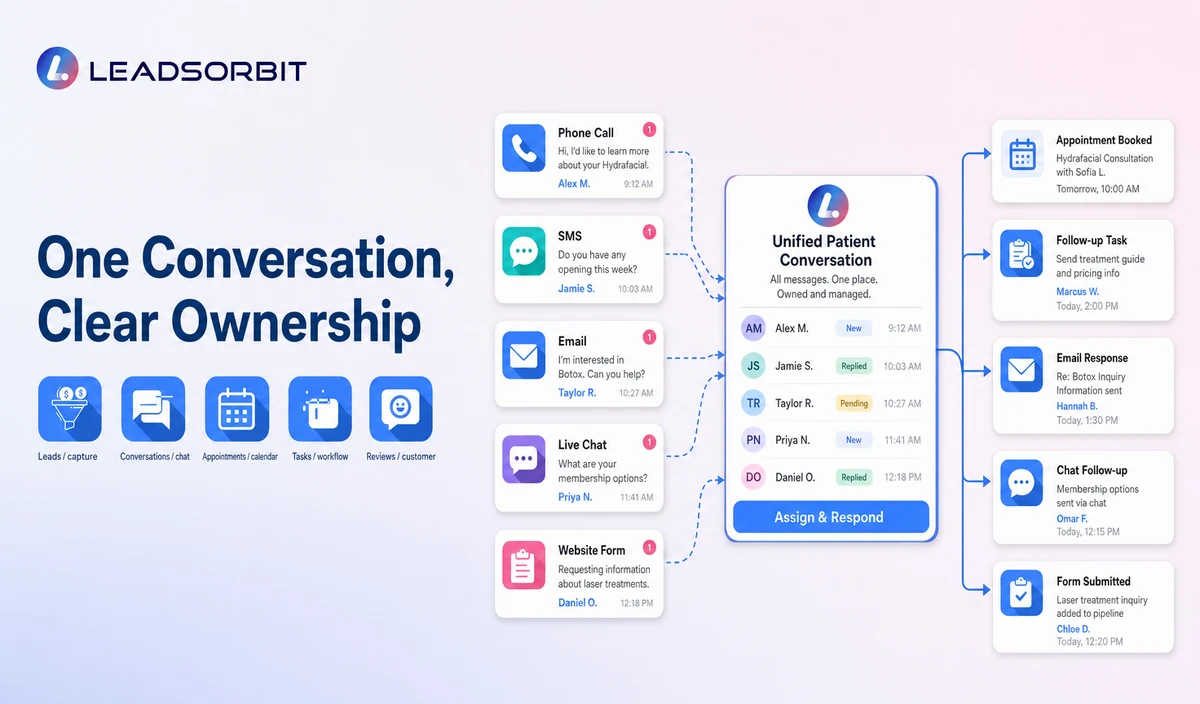
| Communication area | Useful connection | Operational benefit |
|---|---|---|
| Calls | Call activity, owner, recording or summary when enabled, and callback task. | Staff can see why the person contacted the practice. |
| SMS and email | Replies, opt outs, templates, and staff takeover. | The team can continue the conversation without duplicate outreach. |
| Web chat and forms | Source, question, contact details, consultation request, and owner. | New inquiries do not stay disconnected. |
| Appointment messages | Requested, booked, confirmed, reminder, reschedule, cancellation, and no show status. | Communication matches the valid appointment status. |
| Review requests | Eligible trigger, request status, reply, and response task. | Reputation communication becomes part of the administrative journey. |
| CRM tasks and pipeline | Owner, due date, stage, and next action. | The practice can find unowned or overdue conversations. |
Communication Software Is Not a Clinical Record
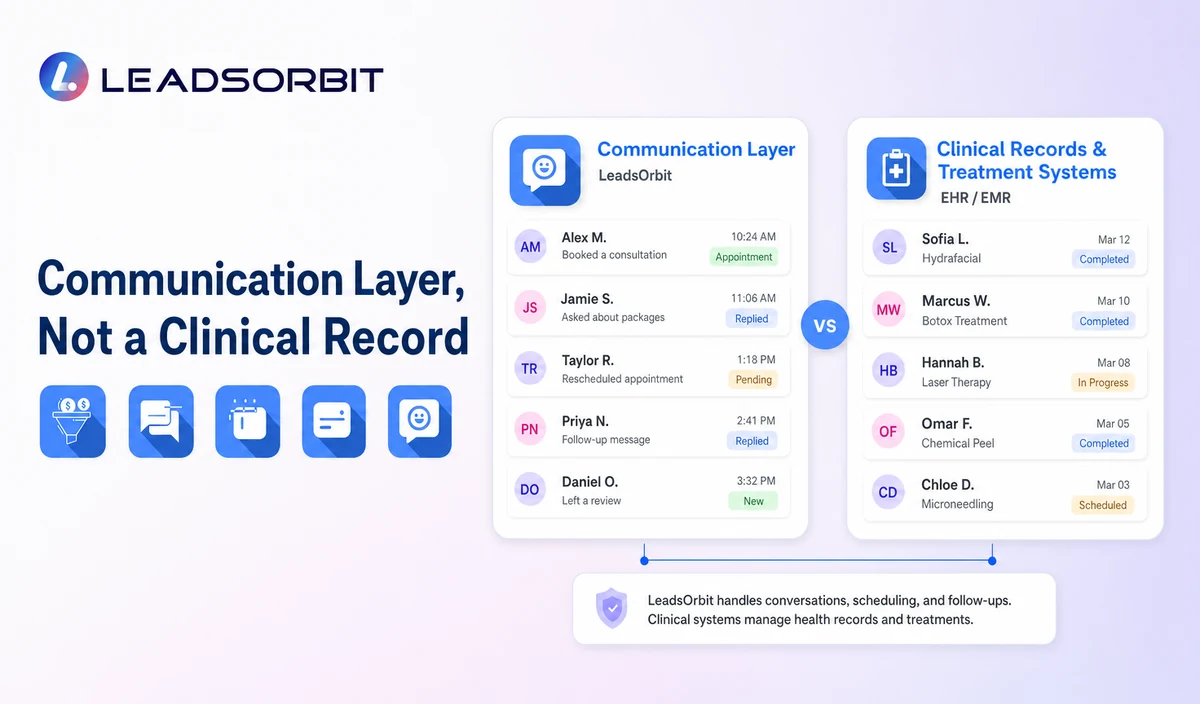
| Administrative communication layer | Approved specialized or clinical process |
|---|---|
| Calls, texts, email, chat, reminders, and review requests. | Medical history, diagnosis, treatment plan, clinical notes, photos, and consents. |
| Consultation requests and staff callbacks. | Suitability assessment, contraindication screening, prescribing, and complication management. |
| Conversation history and task ownership. | Billing, deposits, memberships, package balances, and payment records unless separately verified. |
| Minimum contact fields and statuses. | Clinical records and professional judgment. |
| Configured automation and human handoff. | Full medical spa practice management or EHR replacement. |
Communication Needs Across the Patient Journey
| Journey stage | Primary communication need | Workflow handoff |
|---|---|---|
| New inquiry | Acknowledge, answer approved office questions, and offer consultation or callback. | Move to booking, staff review, or limited follow up. |
| Consultation requested | Clarify availability, location, provider, and next status. | Move to booked, needs review, or follow up. |
| Booked or confirmed | Send accurate confirmation, reminders, and change options. | Suppress acquisition messages and monitor exceptions. |
| Reschedule or cancellation | Update the valid calendar status and stop obsolete messages. | Create staff review when the change cannot complete. |
| Missed appointment | Use the approved recovery path without blame. | Move to rebooked, staff review, later, or closure. |
| Completed visit | Use only approved administrative follow up, review, or retention workflows. | Exclude complaints and sensitive cases. |
| Inactive relationship | Use approved reactivation or maintenance criteria. | Stop after opt out, reply, booking, or attempt limit. |
A Practical Communication Workflow
| Stage | Communication event | System action | Human responsibility |
|---|---|---|---|
| 1. Message arrives | A call, text, email, chat, form, or appointment reply enters. | Create or update the contact and preserve supported context. | Review sensitive and unclear requests. |
| 2. Intent and routing | The person requests booking, a change, office information, or a callback. | Route to the approved workflow and owner. | Take over when the request is complex or outside approved content. |
| 3. Appointment action | The person books, confirms, changes, or cancels. | Update the valid status and suppress obsolete messages. | Resolve calendar, provider, location, or policy exceptions. |
| 4. Follow up task | The request needs a person. | Create an owner, task, and due date. | Complete, document, or reassign the task. |
| 5. Conversation closure | The request is resolved, booked, opted out, or inactive. | Stop related automation and record the outcome. | Confirm status accuracy. |
| 6. Operational review | Managers examine missed replies, overdue tasks, failed messages, and repeated errors. | Show the pattern across channels. | Improve routing, staffing, templates, or configuration. |
Two Way Messaging Should Change the Workflow
Two way messaging is useful only when a reply changes the status or creates a task. A person who replies RESCHEDULE, CALLBACK, HELP, QUESTION, or STOP should not continue receiving the same sequence.
- Identify the medical spa and purpose of the message.
- Use reply options only when the system and staff can support them.
- Pause or stop automation after a meaningful reply.
- Show the reply to the assigned team member.
- Preserve consultation or appointment context.
- Do not request detailed medical, photo, consent, treatment, membership, package, or payment information in routine messaging.
- Honor opt outs and communication preferences.
Staff Ownership and Escalation Rules
| Request type | Primary owner | Escalation rule |
|---|---|---|
| New consultation inquiry | Front desk or consultation owner | Escalate unsupported categories, conflicts, or repeated failures. |
| Existing appointment change | Scheduling owner | Escalate provider, location, accessibility, or policy exceptions. |
| General office question | Front desk | Escalate when the answer is not approved or current. |
| Complaint or privacy message | Practice manager or leadership owner | Pause routine automation and use the approved process. |
| Clinical or treatment question | Qualified practice staff | Do not answer through routine automation. |
| Failed delivery or unowned task | Workflow administrator or backup owner | Correct the data, channel, or assignment before continuing. |
HIPAA Enabled Communication Positioning
LEADSORBIT supports HIPAA compliant administrative workflows for eligible healthcare organizations through HIPAA enabled HighLevel subaccounts. Compliant use depends on maintaining the active HIPAA package, applicable agreements, approved account configuration, user permissions, integrations, retention settings, and the healthcare organization’s own procedures.
Names, phone numbers, email addresses, consultation interests, appointment details, call activity, messages, and conversation history may be PHI depending on context. Use minimum contact and operational information and review every channel, calendar, recording service, AI tool, permission, retention rule, and data destination.
What to Evaluate Before Choosing a Platform
- Which channels are connected and which remain separate?
- Can staff see administrative context without exposing unnecessary clinical data?
- How are replies routed and assigned?
- Does automation stop after booking, opt out, or human takeover?
- How are appointment changes synchronized?
- What permissions, retention, export, audit, and deletion controls are available?
- Which integrations receive identifiable healthcare information?
- How are recording, transcription, summaries, and notices configured?
- Can the practice keep clinical records outside the communication layer?
See the Communication Workflow With Your Channels
Book a Demo to map your calls, texts, email, web chat, appointment messages, conversation history, tasks, and escalation rules inside LEADSORBIT.
How LEADSORBIT Supports Medical Spa Communication
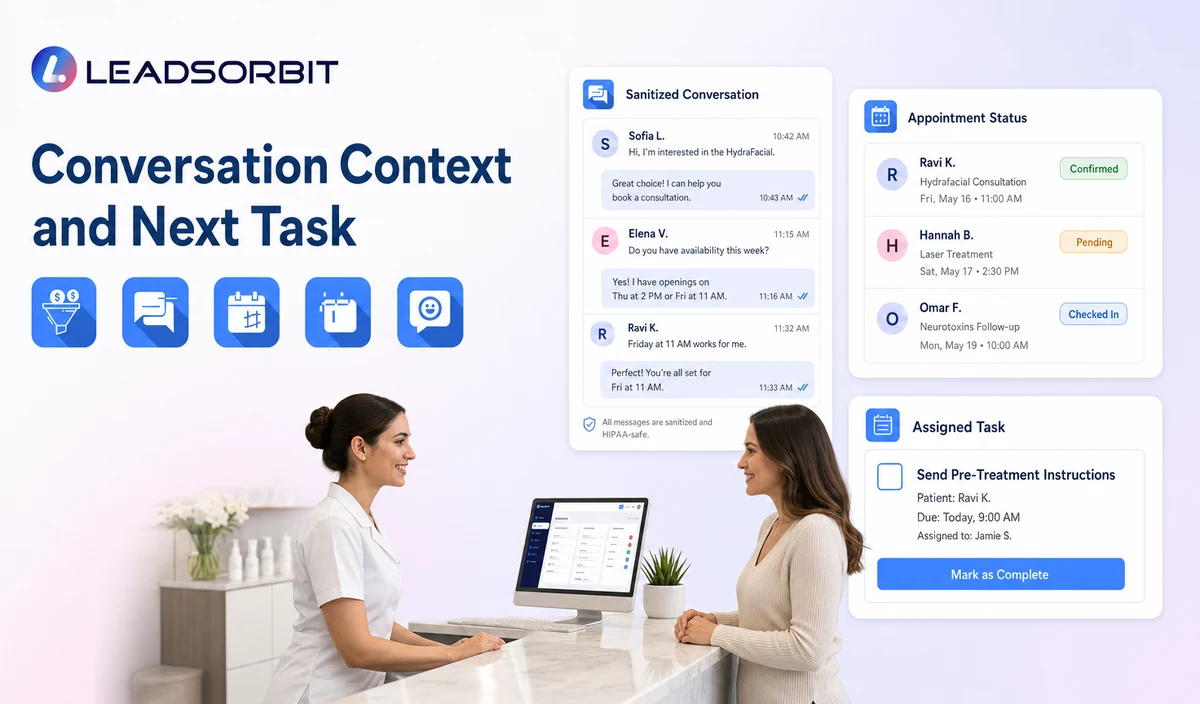
LEADSORBIT’s AI powered CRM connects administrative conversations with CRM context, booking, workflows, and tasks.
- Conversation AI: chat, SMS, and social conversations, routing, AI assisted replies, staff takeover, and CRM synchronization.
- Workflow AI: triggers, messages, conditions, tasks, timing, and stop logic.
- AI Appointment: booking, confirmations, reminders, rescheduling, and cancellation.
- CRM records and tasks: contact context, assigned owner, next action, and status visibility.
Exact channels, email/calling behavior, field mapping, permissions, recording/transcription, retention, integrations, and healthcare configuration must be verified.
Try LEADSORBIT free for 14 days
FAQs
It is an administrative communication layer that connects supported calls, texts, email, chat, appointment messages, CRM context, and staff tasks.
Final Thoughts
The value of medical spa patient communication software is not the number of channels. It is whether the practice can see the conversation, assign the next step, stop the wrong automation, and keep clinical work in the correct system.
Book a Demo to see how LEADSORBIT can connect medical-spa calls, texts, appointment messages, tasks, and CRM visibility.
Start Your Free 14 Day Trial
Try LEADSORBIT and see how it captures missed calls, follows up instantly, and turns leads into booked appointments for your business.