
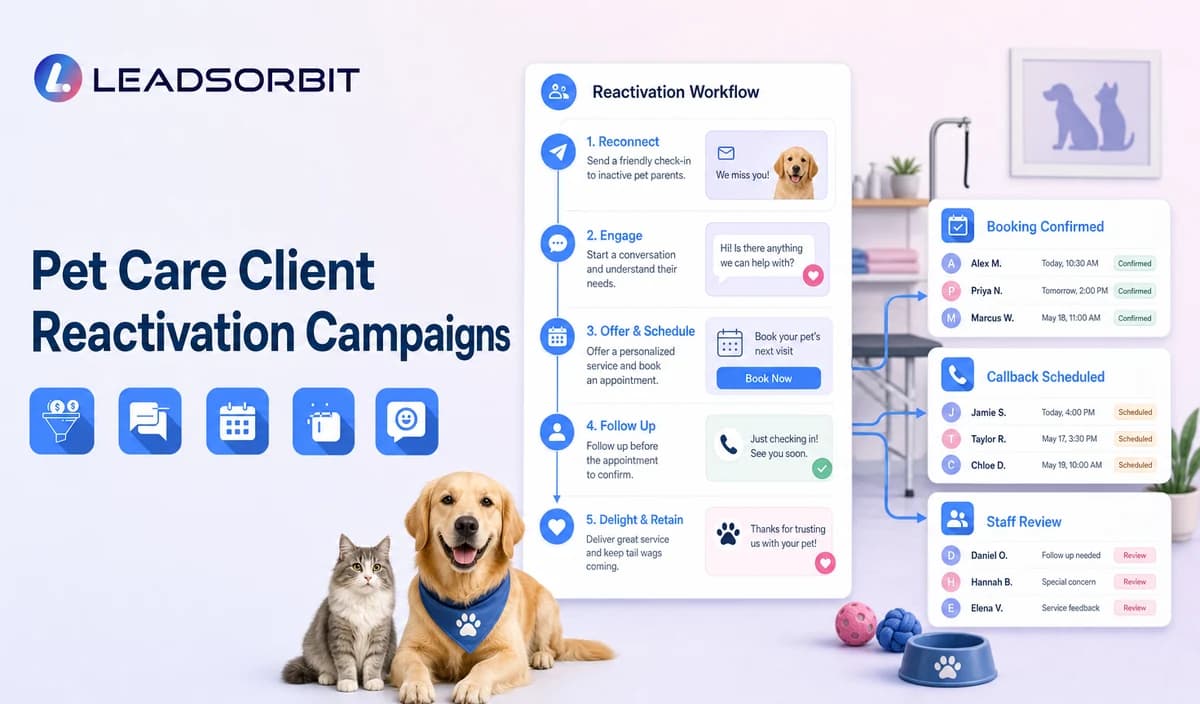

A lapsed pet care client list can contain people with very different histories: a completed daycare visit, a past boarding reservation, a walking or sitting inquiry, a training client, a grooming referral, or a client who asked not to receive promotional messages. One generic campaign is rarely appropriate.
Pet care client reactivation campaigns should begin with a reviewed audience, a clear service specific purpose, and appropriate consent. The broader automation foundation remains with lead follow up automation for small business.

Who This Guide Is For
- Pet care businesses with lapsed or inactive client records.
- Teams segmenting by last service, service type, location, or consent.
- Owners who need promotional and operational messaging separated.
- Multi service businesses coordinating different booking links and owners.
Build Segments Before Writing Messages
The campaign should be relevant enough to feel useful without implying that the pet needs care, grooming, training, health treatment, or another service.
- Past clients without a future booking.
- Dormant inquiries that never booked.
- Prior service category clients where the data is accurate.
- Seasonal or event based audiences under an approved business rule.
- Membership or package clients only when status is verified.
- Location specific segments with appropriate consent.
A Practical Pet Care Client Reactivation Campaigns Workflow
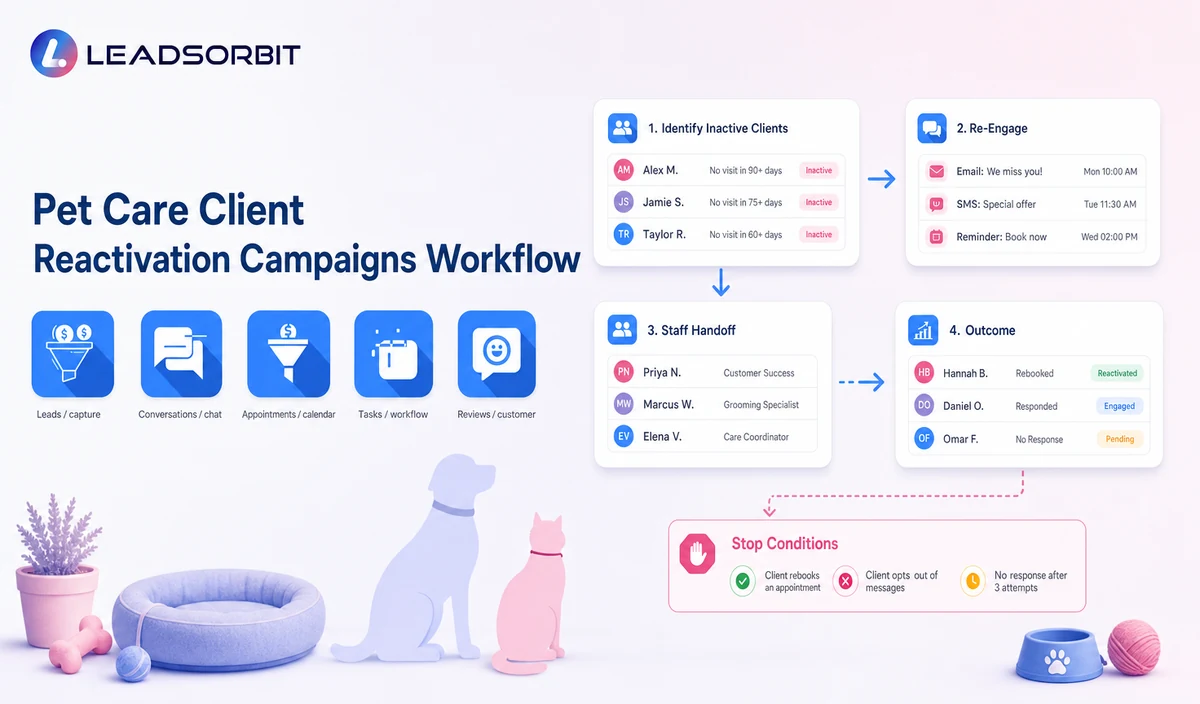
| Stage | Workflow action | Staff responsibility | Stop or escalation rule |
|---|---|---|---|
| 1. Define segment | Apply approved inactivity, source, service, location, consent, and status criteria. | Review sample records and exclusions. | Do not activate an unclear audience. |
| 2. Define purpose | Choose a general return, service specific, seasonal, or prior client message. | Confirm relevance and permission. | Do not imply a health, behavior, or care need. |
| 3. Send first message | Identify the business and offer booking or staff help. | Monitor failed delivery and complaints. | Stop after booking, reply, opt out, invalid contact, or takeover. |
| 4. Route replies | Handle BOOK, CALLBACK, LATER, HELP, negative reply, or STOP. | Own package, membership, health, behavior, policy, or complaint responses. | Pause after reply. |
| 5. Booking or task | Offer the correct service and location path. | Resolve capacity, route, staff, special care, and policy questions. | Stop after a valid outcome. |
| 6. Limited reminder | Send one approved reminder where appropriate. | Review continued eligibility. | Stop at the campaign limit. |
| 7. Suppression and outcome | Record booked, later, no response, complaint, invalid, opt out, or closed. | Prevent suppressed records from re entering. | Do not recycle automatically. |
| 8. Campaign review | Review results, workload, data errors, and client feedback. | Approve changes before the next segment. | Pause problematic campaigns. |
Pet Care Reactivation Segment Examples
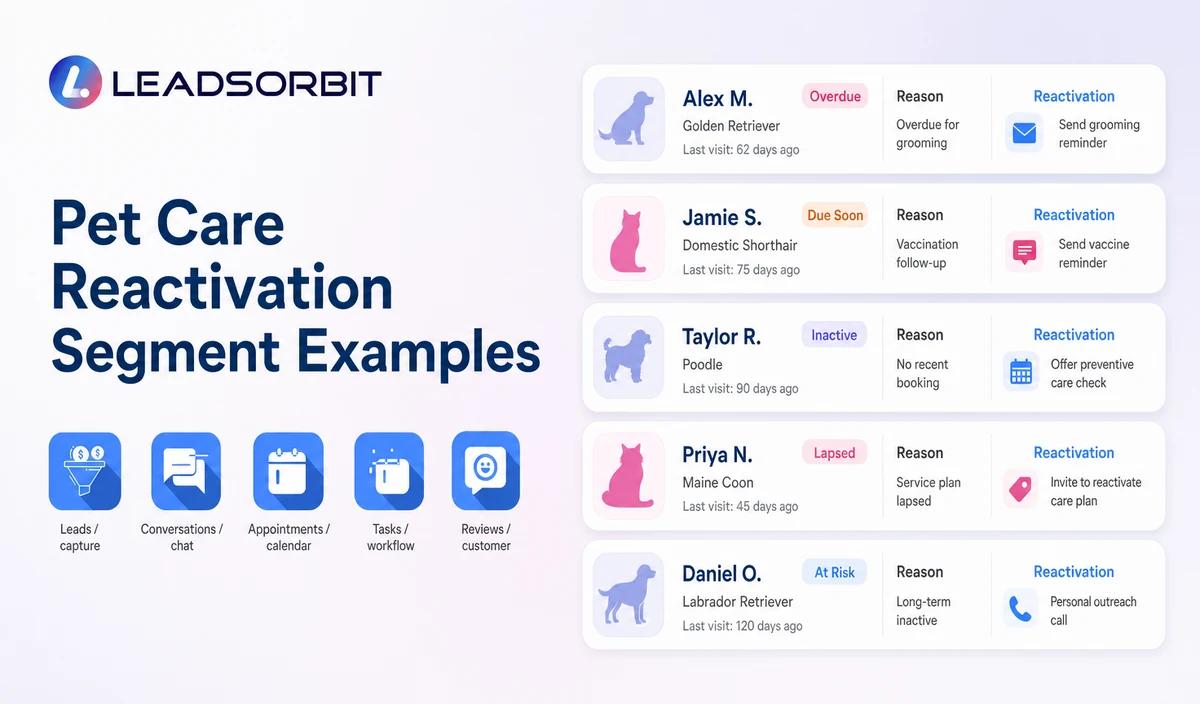
Each audience should have a distinct and evidence based reason to hear from the business.
| Past daycare or boarding clients | General return or approved seasonal invitation. | Do not imply capacity or eligibility. |
|---|---|---|
| Past walking or sitting clients | Service area and timing invitation where appropriate. | Do not promise route or staff availability. |
| Past training clients | General follow up or approved class inquiry. | Do not diagnose behavior or promise outcomes. |
| Dormant inquiries | Simple booking or callback invitation. | Keep separate from established client messaging. |
| Membership or package clients | Use verified status and the correct renewal workflow. | Do not claim balances or benefits without data. |
| Grooming specific clients | Use the Pet Grooming cluster and workflow when the intent is specifically grooming. | Avoid duplicate ownership. |
Practical Scripts and Templates
General Return
Service Specific Campaign
Prior Service Context
Final Message
Important Boundaries
- Use appropriate consent for promotional outreach.
- Do not imply a pet needs health, grooming, training, behavior, or care services without verified context.
- Do not use veterinary, medication, vaccination, or fear based claims.
- Do not use one generic campaign for every service.
- Do not claim package, membership, capacity, route, or service history without verified data.
- Do not continue after opt out, complaint, booking, or staff takeover.
Privacy, Consent, and Pet Parent Data
Pet parent names, phone numbers, pet names, service preferences, reservation details, location, access notes, membership or package status, conversation history, and prior service context are personal business data. Collect only what the workflow needs, keep consent and opt out status visible, limit staff access, and review every form, calendar, messaging provider, AI tool, integration, retention setting, and data destination separately.
LEADSORBIT is positioned here as the communication, booking, follow up, CRM, review, and task layer. Do not present it as a veterinary practice system, pet medical record system, kennel management platform, boarding capacity engine, dog walking GPS or route system, staff scheduler, care log platform, POS, invoicing, payroll, inventory, package accounting, membership billing, or specialized pet business operations system.
The FCC consent and revocation order discusses consent and reasonable revocation methods for certain automated communications. The business should review its exact audience, message type, technology, consent record, and jurisdiction with qualified advisers.
Common Pet Care Workflow Mistakes
- Sending every old client the same promotion.
- Including active bookings or open conversations.
- Using inaccurate last service, pet, or service data.
- Treating operational consent as blanket promotional consent.
- Using pressure, fear, or unsupported service need claims.
- Recycling opt outs or complaints into the next campaign.
Pet Care Workflow Setup Checklist
- Define lapsed, dormant, and later contact criteria.
- Separate daycare, boarding, walking, sitting, training, grooming, membership, package, and seasonal audiences.
- Exclude active bookings, open conversations, opt outs, duplicates, complaints, and invalid contacts.
- Confirm promotional consent and permitted channels.
- Approve the first message, one reminder, and reply paths.
- Use the correct service, location, booking link, and staff owner.
- Review results before activating the next segment.
See the Workflow With Your Business Rules
Start 14 days free trial to map the exact triggers, service categories, messages, booking or callback paths, owners, data sources, permissions, and stop rules for your pet care business inside LEADSORBIT.
What to Measure
- Eligible and excluded records.
- Delivery failures.
- Replies by booking, callback, later, help, complaint, and opt out.
- Valid bookings connected with the campaign.
- Staff tasks created and resolved.
- Duplicates, complaints, and suppression errors.
How LEADSORBIT Supports This Pet Care Workflow
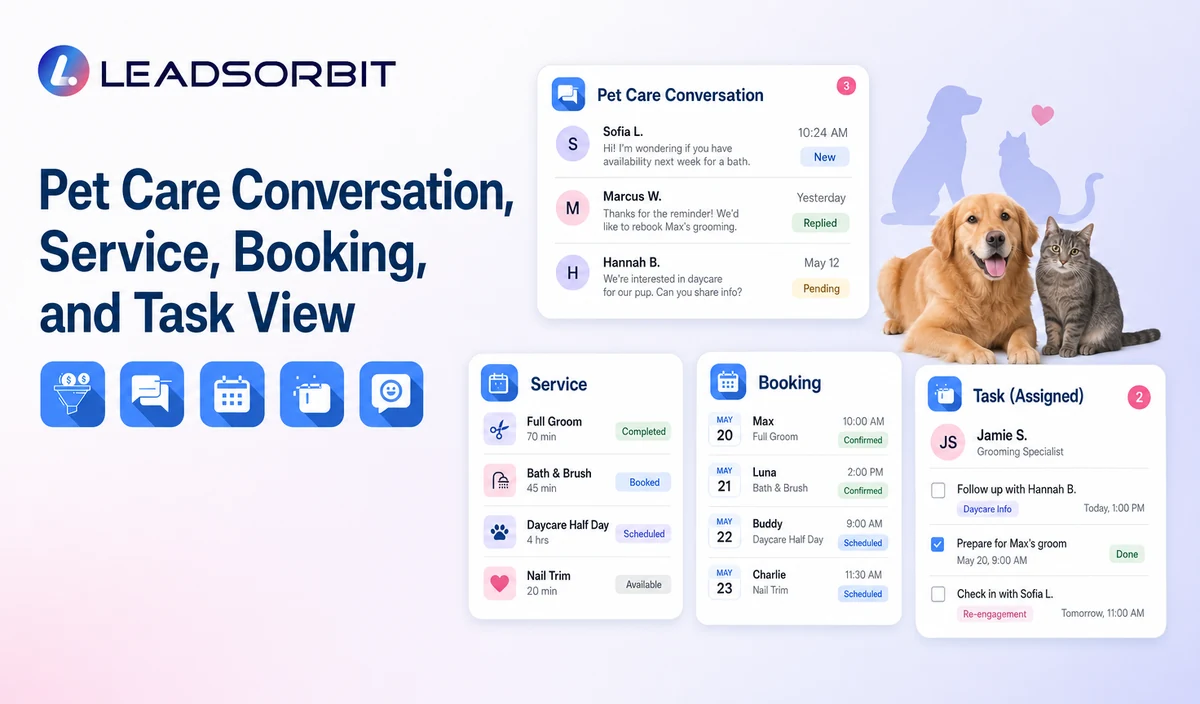
LEADSORBIT’s AI powered CRM can connect approved pet care conversations, booking activity, follow up, tasks, and communication statuses.
- Workflow AI: supports configurable triggers, conditions, messages, tasks, timing, and stop or switch logic.
- Conversation AI: supports configured channel conversation visibility, routing, staff takeover, and CRM synchronization.
Exact channels, fields, scripts, calendars, service rules, pet and client data, capacity or route sources, membership or package information, permissions, retention, integrations, and account behavior require implementation validation. LEADSORBIT is positioned here as the communication, booking, follow up, CRM, review, and task layer. Do not present it as a veterinary practice system, pet medical record system, kennel management platform, boarding capacity engine, dog walking GPS or route system, staff scheduler, care log platform, POS, invoicing, payroll, inventory, package accounting, membership billing, or specialized pet business operations system.
Try LEADSORBIT free for 14 days
FAQs
It is limited outreach to an approved lapsed client or dormant inquiry segment with booking or staff help options.
Final Thoughts
Pet care client reactivation campaigns are limited outreach workflows for approved lapsed client segments. They use verified last service, service type, location, seasonal, or prior inquiry context where appropriate, offer booking or staff help, and stop after reply, booking, opt out, complaint, invalid contact, or the campaign limit. The strongest setup uses accurate source data, gives staff clear ownership, avoids health or capacity promises, and stops automation at the right time.
Start 14 days free trial to see how LEADSORBIT can support this pet care workflow with conversations, booking requests, automation, tasks, and CRM visibility.

Start Your Free 14 Day Trial
Try LEADSORBIT and see how it captures missed calls, follows up instantly, and turns leads into booked appointments for your business.