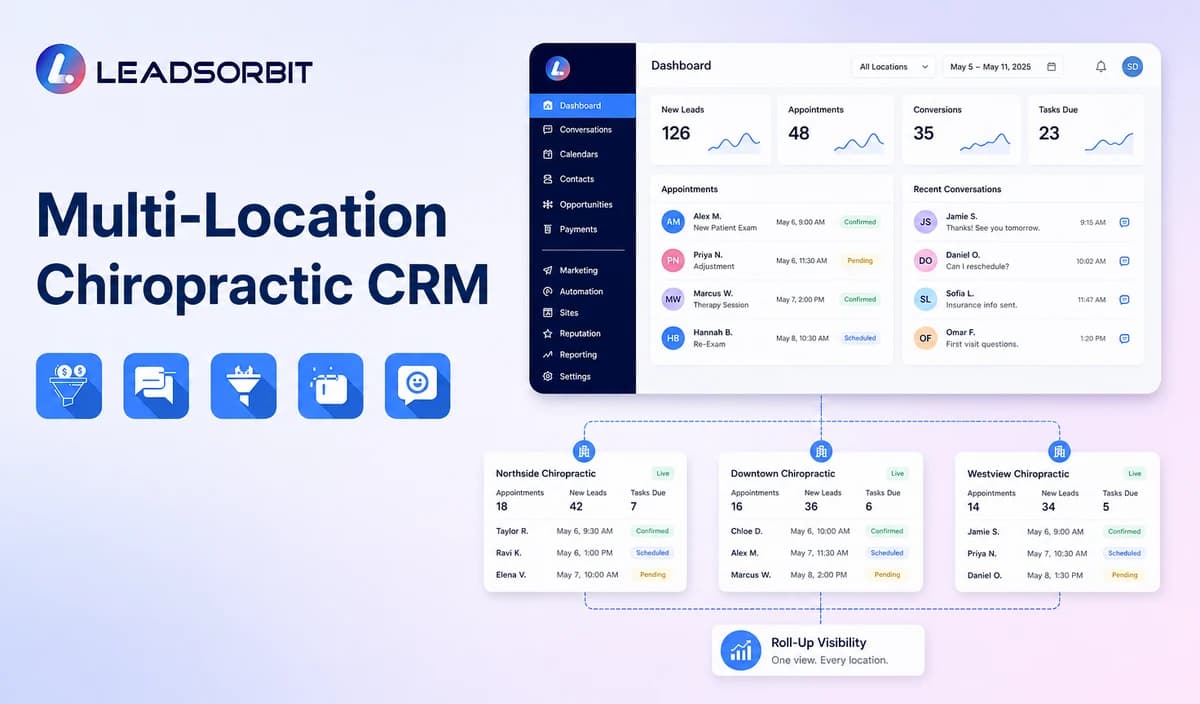

A multi location chiropractic group needs consistency without making every clinic operate as though it were the same office. The CRM must route each inquiry to the correct location, calendar, phone number, review destination, staff team, and reporting view while protecting access to identifiable healthcare information.
This multi location chiropractic CRM guide focuses on administrative coordination across clinics. It does not position LEADSORBIT as a multi site EHR, billing platform, clinical record, or full chiropractic practice management replacement. The broad CRM pipeline framework remains with CRM pipeline stages for small business lead follow up, and the commercial chiropractic owner remains LEADSORBIT for chiropractic clinics.

Who This Guide Is For
- Chiropractic groups operating two or more clinic locations.
- Franchise, regional, or management teams that need shared standards and local control.
- Front desk teams routing inquiries between locations, calendars, and providers.
- Marketing and operations leaders reviewing leads, bookings, reviews, and campaign activity by location.
- Healthcare organizations that need HIPAA enabled subaccounts, permissions, integrations, and data governance reviewed location by location.
What Should Be Centralized and What Should Stay Local?
The best multi location design centralizes standards and reporting while preserving the local details that determine whether an inquiry reaches the right team.
| Centralized where appropriate | Location specific where required |
|---|---|
| Approved pipeline definitions, task standards, and reporting categories. | Phone numbers, addresses, hours, booking links, calendars, providers, and appointment types. |
| Brand voice, baseline templates, compliance rules, and QA. | Local team members, ownership, reply paths, escalation contacts, and exceptions. |
| Campaign naming, source categories, and shared dashboards. | Location consent settings, review destination, listing profile, and message sender. |
| Leadership visibility and aggregate performance review. | Patient facing instructions, directions, parking, and local service availability. |
| Security standards and minimum data rules. | User access, subaccount enablement, integrations, retention, and local workflow testing. |
A Practical Multi Location Chiropractic CRM Architecture
The final architecture may use separate subaccounts, location records, teams, pipelines, or other structures. The implementation team should choose the design only after reviewing privacy, operations, reporting, and support requirements.
| Layer | Purpose | Required validation |
|---|---|---|
| Brand / organization layer | Shared governance, approved templates, naming rules, reporting definitions, and leadership oversight. | Confirm which settings, assets, and reports can be managed centrally. |
| Location layer | Local phone, address, hours, calendars, review links, listings, users, and workflows. | Confirm location separation, subaccount structure, HIPAA enablement, and local data boundaries. |
| User and role layer | Give each employee access to the locations and functions needed for the job. | Test role based permissions, cross location visibility, exports, mobile access, and reassignment. |
| Lead and conversation layer | Route calls, forms, chat, SMS, email, and social inquiries to the correct location and owner. | Validate source mapping, requested location, geographic rules, phone numbers, landing pages, and fallback queues. |
| Appointment layer | Connect approved calendars, appointment types, staff availability, confirmations, reminders, and changes. | Validate time zones, hours, providers, buffers, double booking controls, and exception handling. |
| Reputation and listing layer | Use the correct review destination and maintain accurate public location information. | Validate listing ownership, location links, review requests, response permissions, and duplicate profiles. |
| Reporting layer | Compare location level and roll up operational performance. | Confirm metrics, filters, attribution limits, permissions, refresh timing, and export controls. |
Location Aware Lead Routing
Routing should use reliable signals and a clear fallback. A postal code or page URL alone may not be enough when patients travel between locations or choose a particular provider.
| Routing signal | Useful application | Fallback rule |
|---|---|---|
| Location specific phone number | Route calls and missed call workflows to the associated clinic. | Send uncertain calls to a shared review queue rather than guessing. |
| Location landing page or form | Assign inquiries from a clinic specific web destination. | Validate hidden fields and prevent outdated pages from routing incorrectly. |
| Requested location | Use the person’s explicit choice. | Confirm availability and allow staff to change the assignment. |
| Geographic area | Offer nearby locations when approved. | Do not automatically assign care based only on location data. |
| Provider preference | Route to the relevant calendar or staff team where supported. | Do not promise provider availability or clinical suitability. |
| Existing relationship | Keep administrative continuity when the person already belongs to a location workflow. | Use approved transfer and access rules when another clinic must help. |
| Unknown or conflicting data | Create a central triage task. | Assign a human owner and a service rule for unresolved records. |
Calendars, Providers, and Appointment Rules
LEADSORBIT AI Appointment currently describes multi location scheduling, multiple calendars, staff availability, and appointment rules from one dashboard. The exact chiropractic setup still requires implementation validation.
- Use the correct location, time zone, hours, provider, and appointment type.
- Separate Appointment Requested, Booked, Confirmed, Rescheduled, Cancelled, and Needs Review.
- Prevent one location’s calendar from showing another location’s unavailable or unsupported options.
- Route provider, accessibility, insurance, clinical, and other exceptions to staff.
- Suppress obsolete confirmations and reminders after a location or appointment change.
- Test cross location transfers, duplicate contacts, and double booking controls.
Centralized Conversations Without Excess Access
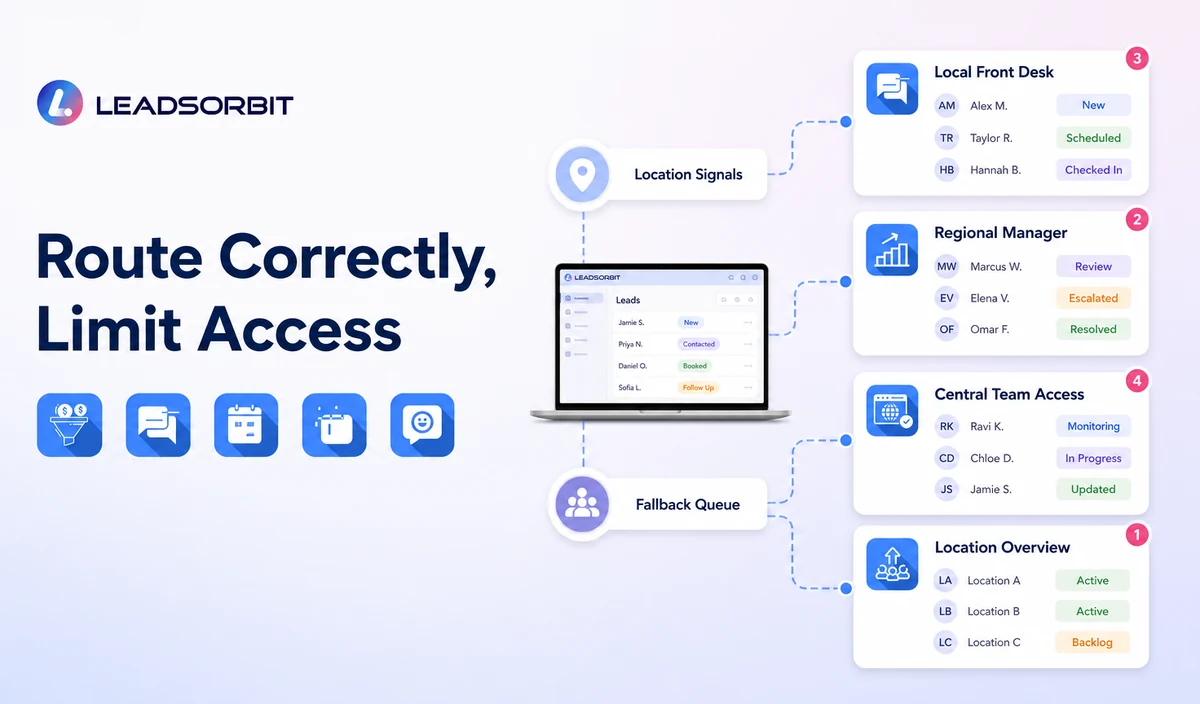
Leadership may need roll up visibility, while local teams should usually see only the conversations and records required for their role. A centralized inbox does not mean unrestricted access to every patient record.
| Role | Typical operational need | Permission question |
|---|---|---|
| Local front desk | Own local inquiries, appointments, replies, and tasks. | Can the user see only the assigned location and approved shared queues? |
| Regional manager | Review unresolved work and operational trends across assigned locations. | Can access be limited to the region and appropriate data fields? |
| Central booking team | Route inquiries and book across approved calendars. | Which locations, appointment types, and patient data can the team access? |
| Marketing team | Review source, campaign, review, and listing performance. | Can reporting use aggregate or minimum data without exposing message content? |
| Administrator | Configure users, templates, workflows, integrations, and reporting. | How are privileged actions audited and reviewed? |
| Temporary or backup staff | Cover defined tasks during absences. | Can access expire or be removed promptly after coverage ends? |
Multi Location Reviews and Listings
LEADSORBIT Reviews AI describes multi location templates and permissions, while Listing AI describes centralized location management, bulk updates, and branch level reporting. Each clinic still needs the correct review destination and public listing information.
| Area | Central standard | Local requirement |
|---|---|---|
| Review requests | Neutral wording, eligibility rules, reminder limits, privacy and response standards. | Correct location specific review link and local response owner. |
| Review monitoring | Shared escalation categories and response time expectations. | Location access, context, and approval path. |
| Listings | Brand naming, NAP standards, categories, and change control process. | Accurate address, phone, hours, services, maps, and verification. |
| Responses | Privacy safe templates and leadership escalation rules. | Do not confirm patient status or disclose local care details. |
| Reporting | Roll up visibility for review activity and listing performance. | Validate platform connection, attribution, and permissions by location. |
Reporting Across Locations
LEADSORBIT Reporting and Analytics currently describes multi location and user filters as well as global, regional, and location level performance views. The reporting model must still be validated against the fields and workflows used by the chiropractic group.
- Use the same definitions for New Inquiry, Contacted, Appointment Requested, Booked, Confirmed, Completed, No Show, Nurture, and Closed.
- Compare locations only when data definitions, time zones, and date ranges are consistent.
- Separate requested appointments from valid bookings.
- Document attribution limitations for calls, forms, campaigns, referrals, and offline sources.
- Use role based reporting access and minimum necessary data.
- Review missing owners, overdue tasks, failed messages, duplicate records, and workflow exceptions.
- Avoid unsupported revenue, patient, clinical, or performance claims.
HIPAA Enabled Multi Location Data Governance
LEADSORBIT supports HIPAA compliant administrative workflows for eligible healthcare organizations through HIPAA enabled HighLevel subaccounts. Compliant use depends on maintaining the active HIPAA package, applicable agreements, approved account configuration, user permissions, integrations, retention settings, and the healthcare organization’s own procedures.
A multi location healthcare setup adds questions about which subaccounts are HIPAA enabled, where information is stored, who can view cross location records, how conversations are transferred, and which integrations operate at the brand or local level.
| Governance question | Required check |
|---|---|
| Subaccount enablement | Confirm every applicable healthcare subaccount or location environment is HIPAA enabled. |
| Agency and customer agreements | Store current agency evidence and keep customer facing BAA status as BAA CHECK until leadership locks the policy. |
| Cross location visibility | Define which roles can view, edit, export, transfer, or report on identifiable healthcare data. |
| Shared contacts | Decide how duplicate or cross location patient records are resolved without unnecessary disclosure. |
| Calendars and forms | Review every location’s fields, titles, notes, permissions, and integrations. |
| Recording and transcription | Confirm enablement, notices, consent, jurisdiction, access, correction, retention, and transfer rules. |
| Reporting and exports | Use minimum necessary fields and limit sensitive conversation or appointment details. |
| Vendor and integration scope | Review each communication provider, AI tool, calendar, listing platform, review platform, storage system, and data destination separately. |
A Phased Multi Location Implementation Plan
| Phase | Scope | Exit criteria |
|---|---|---|
| 1. Discovery | Document locations, users, phone numbers, forms, calendars, providers, review links, listings, workflows, reports, and healthcare requirements. | Approved architecture and dependency register. |
| 2. Pilot location | Configure one representative clinic and test the full inquiry to reporting journey. | Routing, booking, replies, permissions, healthcare settings, and reporting pass QA. |
| 3. Shared standards | Create approved templates, stage definitions, naming, roles, escalation, and change control. | Leadership, operations, product, and compliance approval. |
| 4. Controlled rollout | Add locations in manageable groups with local validation. | Every location passes routing, calendar, messaging, review, listing, permission, and data checks. |
| 5. Roll up reporting | Enable location and regional views after definitions are consistent. | Reports reconcile with source records and access rules. |
| 6. Ongoing governance | Review users, permissions, integrations, template versions, errors, and compliance evidence. | Documented review schedule and accountable owners. |
Common Multi Location CRM Mistakes
- Copying one location’s phone, hours, calendar, or review link into every template.
- Giving central or regional users broader healthcare data access than they need.
- Routing by geography without allowing patient choice or human correction.
- Comparing locations that use different stage definitions or data entry rules.
- Assuming every subaccount, calendar, messaging provider, and integration has the same healthcare configuration.
- Publishing central template changes without testing local merge fields.
- Treating a requested appointment as a booked appointment.
- Using roll up reporting as proof of exact attribution or clinical performance.
- Positioning the CRM as a multi site EHR, billing, records, or full practice management platform.
Multi Location CRM Evaluation Checklist
- Confirm the target account and subaccount architecture.
- List every location, phone number, address, hours, provider, calendar, appointment type, and review destination.
- Define routing signals, fallback queues, owners, and service rules.
- Define local, regional, central, marketing, and administrator roles.
- Test cross location visibility, record transfer, duplicate contacts, exports, and mobile access.
- Standardize pipeline stages, task rules, and reporting definitions.
- Confirm shared template controls and local override fields.
- Validate reviews, listings, location pages, forms, calendars, messages, and reporting separately.
- Confirm HIPAA enablement, agreements, permissions, retention, recording/transcription, and integrations for every applicable location.
- Pilot before broad rollout and maintain version, access, and change control records.
See the Multi Location Workflow With Your Organization
Book a Demo to map your locations, lead routing rules, calendars, conversation access, review and listing workflows, permissions, healthcare controls, and roll up reporting inside LEADSORBIT.
How LEADSORBIT Supports Multi Location Chiropractic Workflows
LEADSORBIT currently positions the platform for single location businesses, multi location brands, and franchises. Relevant verified product areas include:
- Workflow AI: configurable workflows that can scale to multi branch setups, with triggers, messages, conditions, tasks, and stop logic.
- Conversation AI: supported channel conversation visibility, CRM synchronization, tasks, routing, and staff takeover.
- AI Appointment: multi location calendars, staff availability, appointment rules, booking, reminders, rescheduling, and cancellation.
- Reviews AI: multi location templates and permissions for review invitations and response workflows.
- Listing AI: centralized listings, bulk location updates, verification, and branch or regional performance views.
- Reporting and Analytics: multi location and user filters with global, regional, or location level reporting.
- Mobile App: mobile access to leads, messages, appointments, campaigns, alerts, and reports.
The exact account architecture, location routing, shared contact behavior, cross location conversation visibility, role permissions, calendar configuration, healthcare data separation, reporting, and integration scope require product and implementation validation before publication as a fully verified commercial guide.
Try LEADSORBIT free for 14 days
FAQs
It is an administrative CRM setup that organizes locations, lead routing, conversations, calendars, reviews, listings, user permissions, tasks, and location level or roll up reporting.
Final Thoughts
A multi location chiropractic CRM succeeds when central standards and reporting coexist with correct local routing, calendars, permissions, review destinations, listings, and healthcare data controls.
Book a Demo to see how LEADSORBIT can support multi location chiropractic lead routing, appointments, conversations, reviews, listings, tasks, and reporting.

Start Your Free 14 Day Trial
Try LEADSORBIT and see how it captures missed calls, follows up instantly, and turns leads into booked appointments for your business.
Personal Message From Faisal Zulfiqar
Multi location automation magnifies both good processes and bad ones. A wrong phone number, review link, permission, or calendar rule becomes a bigger problem when it is copied across every clinic.
Start with one representative location, test the complete journey, and expand only after the team can trust the routing, access, and reporting.