
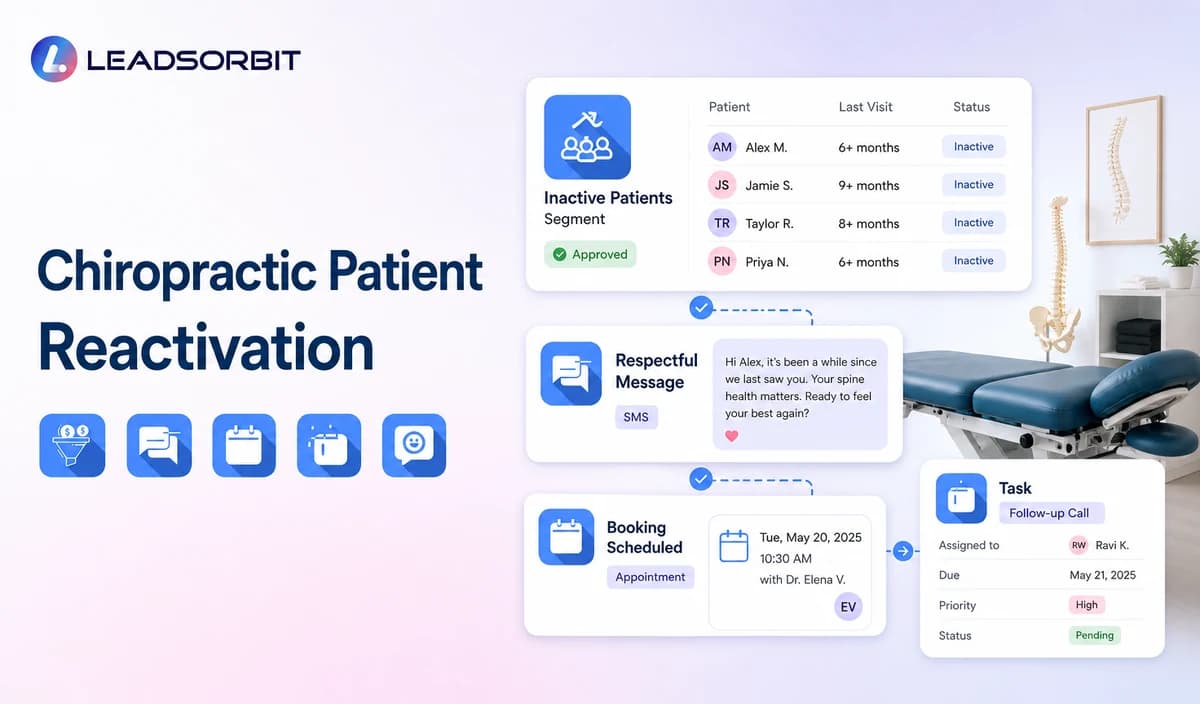

A chiropractic clinic may have former patients or past inquiries who have not scheduled again, but reactivation should not begin with a generic blast to every old contact. The clinic needs an approved segment, a legitimate communication basis, respectful wording, a useful booking or callback path, and clear stop conditions.
This guide focuses on lapsed-patient and inactive-contact re-engagement. The broad automation framework remains with lead follow up automation for small business, while the commercial chiropractic owner remains LEADSORBIT for chiropractic clinics.
Direct answer: A chiropractic patient reactivation campaign is a limited administrative outreach workflow for an approved group of inactive patients or contacts. It identifies the eligible segment, sends a respectful SMS or email, offers a booking or staff-callback path, routes replies, stops after a defined outcome, and reviews results before the next campaign.
Who This Guide Is For
Chiropractic clinics with a usable list of inactive or lapsed contacts.
Office managers who need clear eligibility and exclusion rules before outreach.
Front-desk teams that want booking and reply ownership after a campaign.
Clinic owners who want a repeatable monthly reactivation process instead of occasional bulk messages.
Healthcare organizations configuring HIPAA-enabled administrative outreach workflows.
Reactivation Starts With an Eligible Segment
A campaign should begin with a defined administrative reason for inclusion. The clinic should not assume that every older contact is appropriate to message, and it should not infer clinical need from inactivity.
| Possible segment | Administrative definition | Required review |
|---|---|---|
| Past patient without a future appointment | A valid contact with a completed prior administrative visit and no current booking. | Confirm communication permission, current contact details, exclusions, and appropriate campaign purpose. |
| Unbooked past inquiry | A previous inquiry that did not become a valid appointment. | Separate from patient reactivation when the person never became a patient; use lead follow up rules. |
| Cancelled or no show contact | A person with an unresolved cancelled or missed appointment. | Confirm that the no show or cancellation recovery workflow has ended. |
| Previously active contact | A person whose last administrative visit falls outside the clinic’s chosen review window. | Do not imply that the person medically needs care. |
| Requested later contact | A person who asked the clinic to reconnect during a defined period. | Use the requested timing and preferred channel. |
| Location-specific inactive contact | A valid contact associated with one approved clinic location. | Confirm the correct location, booking link, staff owner, and permissions. |
Who Should Be Excluded
Contacts who opted out or revoked consent.
Invalid, reassigned, or unverified phone numbers and email addresses.
Duplicate records that could receive repeated messages.
Contacts with an active appointment or open staff conversation.
People currently in a complaint, legal, privacy, or sensitive-review process.
Contacts whose communication preference or relationship is unclear.
Records that require clinical judgment to determine whether outreach is appropriate.
Any group selected because the clinic expects a particular medical or revenue outcome.
A Practical Chiropractic Reactivation Workflow
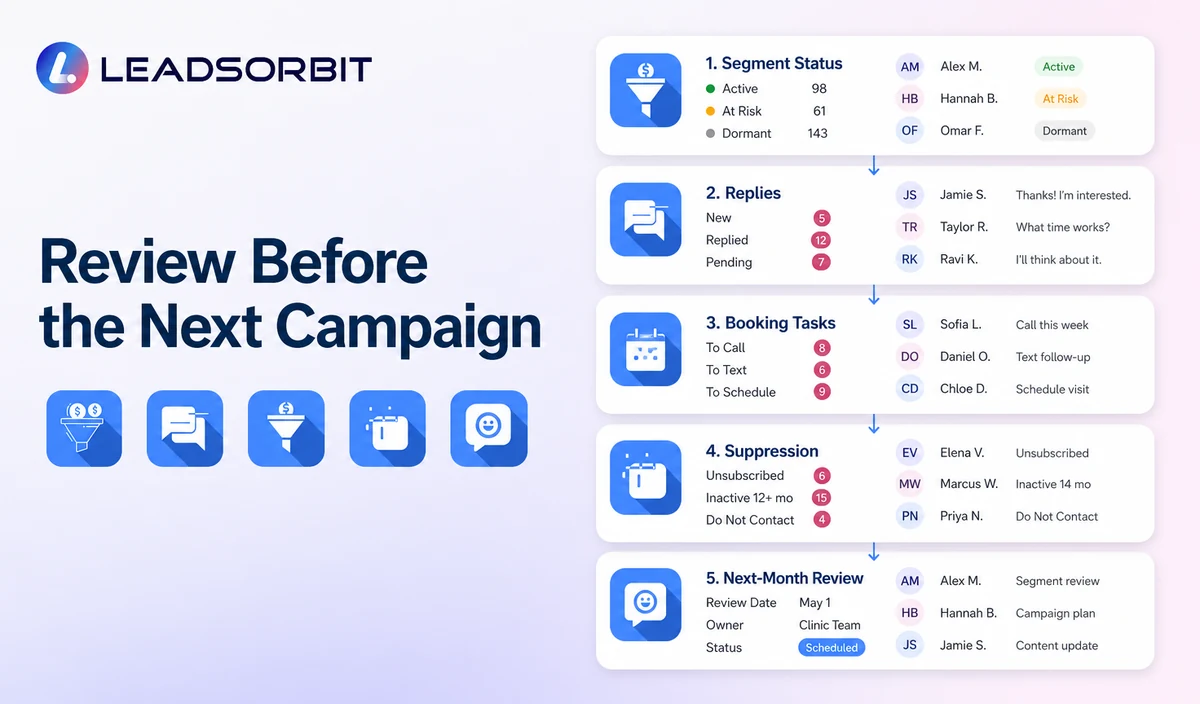
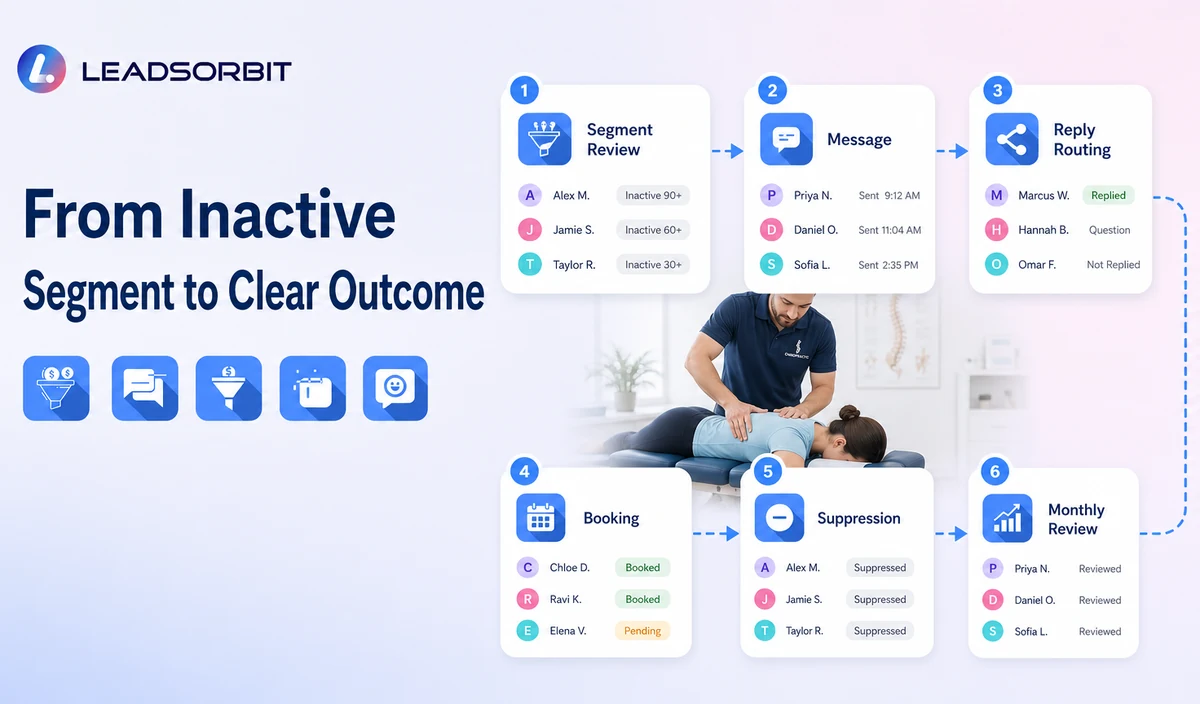
| Stage | Workflow action | Human responsibility | Stop condition |
|---|---|---|---|
| 1. Build the segment | Apply approved inactivity, status, location, and consent criteria. | Review sample records, duplicates, exclusions, and data quality. | Do not activate until eligibility is approved. |
| 2. Validate campaign purpose | Define the administrative reason, message, booking destination, and response owner. | Confirm that wording does not imply clinical need or guaranteed benefit. | Pause when the purpose or audience is unclear. |
| 3. First message | Send the approved SMS or email through the permitted channel. | Monitor delivery failures and sensitive replies. | Stop after booking, reply, opt out, invalid contact, or staff takeover. |
| 4. Reply routing | Interpret approved responses such as BOOK, CALLBACK, LATER, HELP, or STOP. | Own ambiguous, complex, negative, or sensitive replies. | Move non-routine responses to a person. |
| 5. Booking or callback | Offer the valid appointment path or create a named staff task. | Resolve provider, location, timing, or relationship exceptions. | Stop after a valid appointment or documented resolution. |
| 6. Limited reminder | Send one approved reminder only when appropriate. | Review whether the contact should remain active. | Stop at the campaign attempt limit. |
| 7. Outcome and suppression | Record booked, callback, later, no response, invalid, complaint, or opt out status. | Apply the correct future-contact rule. | Do not recycle suppressed records into the next campaign. |
| 8. Monthly review | Evaluate segment quality, replies, bookings, complaints, and staff workload. | Approve changes before the next campaign. | Pause the campaign if errors, confusion, or privacy risk appears. |
Chiropractic Reactivation Text Message Templates
Template 1: Simple Reconnection
Hi [First Name], this is [Clinic Name]. We are checking in with people who have previously contacted or visited our office. Would you like help requesting a future appointment? Reply BOOK, CALLBACK, LATER, or STOP.
Template 2: Booking Path
Hi [First Name], here is the approved booking link for [Clinic Name]: [Booking Link]. If the available times do not work, reply CALLBACK and our team will review your request. Reply STOP to opt out.
Template 3: Staff Callback
Thanks for your reply. A team member from [Clinic Name] will review your callback request during [Office-Hours Expectation]. Please avoid sending medical details by text.
Template 4: Later Follow-Up
Thank you. We will pause this request for now. Reply when you are ready, or use [Booking Link] to request an appointment. Reply STOP to opt out.
Template 5: Final Active Message
Hi [First Name], we will close this reactivation request for now. You can contact [Clinic Name] or use [Booking Link] when it is convenient. Reply STOP to opt out.
Reactivation Email Template
Subject: Would you like help scheduling with [Clinic Name]?Hi [First Name],We are reaching out to people who have previously contacted or visited [Clinic Name]. If you would like help requesting a future appointment, you can use the link below or reply to this email for staff assistance.[Booking Link]No response is required. This message does not provide medical advice or suggest that you need treatment.Thank you,[Clinic Name] Team
Use a Short Cadence With Clear Stop Rules
A reactivation campaign is not an indefinite nurture sequence. The clinic should set the number of messages, the permitted channels, the review window, and the outcome that stops future outreach.
| Campaign point | Purpose | Control |
|---|---|---|
| Initial message | Explain why the clinic is contacting the person and offer a simple next step. | Use the approved segment, sender identity, and opt out method. |
| Limited reminder | Provide one additional opportunity when appropriate. | Do not increase pressure, add clinical claims, or switch channels without approval. |
| Reply | Route BOOK, CALLBACK, LATER, HELP, negative feedback, or sensitive content. | Pause generic automation after a meaningful reply. |
| Booking | Create or confirm the valid appointment path. | Stop the reactivation sequence and begin the correct appointment workflow. |
| No response | Record the defined outcome after the campaign window. | Do not automatically restart the same campaign every month. |
| Opt out or complaint | Suppress future applicable outreach and assign staff review. | Do not attempt to persuade the person to remain in the campaign. |
Reactivation Is Not Care-Plan Enforcement
The campaign should not tell inactive patients that they are overdue for treatment unless the clinic has an approved, clinically governed process outside this marketing workflow. It should not interpret the absence of an appointment as a medical risk.
| Appropriate administrative direction | Avoid |
|---|---|
| Offer help requesting a future appointment. | You need to return for treatment. |
| Ask whether the person wants a booking link or staff callback. | Your condition may get worse if you do not schedule. |
| State that no response is required. | Your care plan requires immediate action. |
| Use neutral language about reconnecting with the clinic. | You are overdue for an adjustment. |
| Move clinical questions to qualified staff. | Automated symptom, treatment, or urgency interpretation. |
Consent, Opt-Outs, and Healthcare Data
Automated texts and calls may be subject to consent and revocation requirements. The FCC’s TCPA guidance discusses consent and revocation for certain automated communications. The clinic should review its audience, message type, technology, consent records, and jurisdiction with qualified advisers.
LEADSORBIT supports HIPAA-compliant administrative workflows for eligible healthcare organizations through HIPAA-enabled HighLevel subaccounts. Compliant use depends on maintaining the active HIPAA package, applicable agreements, approved account configuration, user permissions, integrations, retention settings, and the healthcare organization’s own procedures.
Names, contact details, past appointment status, campaign eligibility, replies, and booking activity may be PHI depending on context. Use minimum contact and operational information, keep clinical details outside the campaign, and review every connected list, messaging provider, calendar, AI tool, and data destination separately.
Monthly Reactivation Review
A campaign becomes safer and more useful when the clinic reviews it as an operating process rather than repeatedly sending the same messages.
Verify the next segment before every launch.
Review duplicates, opt-outs, invalid contacts, and active appointments.
Compare SMS and email delivery failures.
Review replies that required human intervention.
Confirm bookings were attributed only when the connection is supported.
Track complaints, confusion, or privacy concerns.
Identify messages that caused unnecessary staff work.
Check whether previously suppressed records re-entered the segment.
Approve any timing, wording, channel, or eligibility change before reuse.
Reactivation Campaign Setup Checklist
Define lapsed-patient and inactive-contact eligibility in administrative terms.
Separate past patients from unbooked leads.
Exclude active appointments, open conversations, opt-outs, duplicates, complaints, and invalid contacts.
Confirm the legitimate outreach basis and preferred channel.
Approve the first message, one limited reminder, and every reply path.
Use the correct clinic, location, booking link, and callback owner.
Define BOOK, CALLBACK, LATER, HELP, negative-reply, and STOP handling.
Keep clinical details, treatment pressure, and outcome claims outside the campaign.
Confirm permissions, retention, integrations, and HIPAA-enabled account status.
Review results and approve the next campaign rather than running it automatically forever.
See the Reactivation Workflow With Your Clinic’s Segments
Book a Demo to map your inactive-contact segments, messages, booking paths, reply handling, staff tasks, suppression rules, and monthly review inside LEADSORBIT.
What to Measure
Use the clinic’s own baseline and avoid guaranteed-return claims. The most useful measures show whether the campaign reached eligible people and produced a clear, respectful outcome.
Eligible records included and records excluded.
SMS and email delivery failures.
Replies by BOOK, CALLBACK, LATER, HELP, negative feedback, and STOP.
Valid appointments connected with the campaign.
Staff tasks created and resolved.
Contacts moved to suppression or future-review status.
Duplicate messages, complaints, and privacy concerns.
Campaign changes approved before the next launch.
How LEADSORBIT Supports Chiropractic Reactivation
LEADSORBIT’s AI powered CRM can connect contact segments, campaign messages, replies, booking paths, tasks, and status visibility.
Workflow AI: supports triggers, conditions, SMS or email actions, timing, tasks, and stop logic.
Conversation AI: supports supported-channel reply visibility, routing, human takeover, and CRM synchronization.
AI Appointment: supports approved booking, calendar connection, confirmations, rescheduling, and cancellation.
CRM segmentation, tags, records, and tasks: support eligibility review, owner assignment, outcomes, and suppression visibility.
Exact segmentation fields, consent records, channels, timing, booking configuration, permissions, retention, and integrations must be verified before activation.
Ready to automate your growth?
Frequently Asked Questions
It is a limited administrative outreach workflow for an approved group of inactive contacts, offering a booking or callback path and stopping after a defined outcome.
Final Thoughts
A strong chiropractic patient reactivation campaign starts with the right segment, uses respectful language, offers one clear next step, and protects people from repeated or inappropriate outreach.
Book a Demo to see how LEADSORBIT can connect chiropractic reactivation segments, messages, booking, staff tasks, and campaign outcomes.

Book a Demo
See how LEADSORBIT captures missed calls, follows up instantly, and moves leads into booked appointments, using the exact workflow your business needs.