
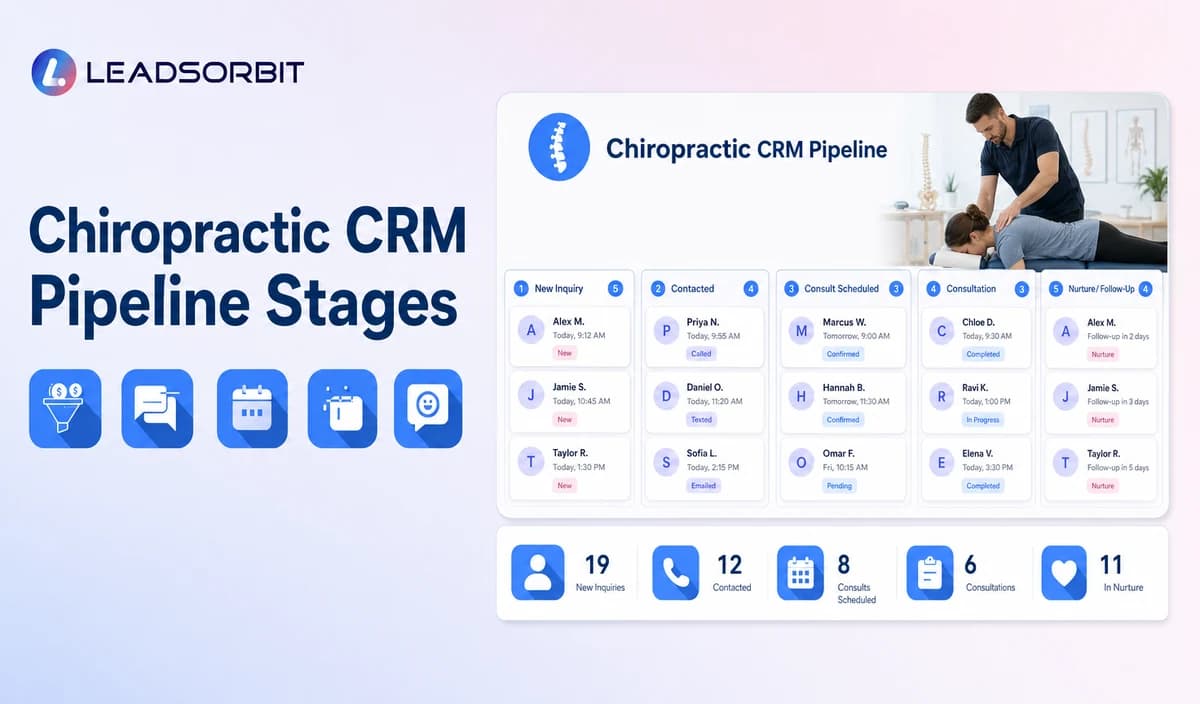

A chiropractic CRM pipeline should answer one practical question: what needs to happen next for each new inquiry? Without clear stages, a contact may sit in a generic list even though the clinic has already called, offered a booking link, confirmed an appointment, or decided to pause follow up.
This guide provides a non-clinical pipeline for new patient communication and appointment follow up. It builds on the broader CRM pipeline stages for small business lead follow up framework while keeping broad chiropractic software terms with the existing chiropractic industry page.

Who This Guide Is For
- Chiropractic clinic owners who need visibility across new patient inquiries.
- Front desk teams managing calls, forms, chat, booking, and callbacks.
- Office managers defining ownership and follow up standards.
- Teams that currently use spreadsheets, inboxes, or generic contact lists.
- Clinics that want administrative lead tracking without turning the CRM into a clinical record.
What a Pipeline Stage Is, and Is Not
A stage is a shared operational status. It tells the team where an inquiry stands and which action is due. It should not contain detailed medical information, substitute for a patient chart, or describe a clinical outcome.
| A useful stage does | A useful stage does not |
|---|---|
| Describe the inquiry's administrative position. | Diagnose or classify a medical condition. |
| Trigger a clear owner and next task. | Replace a clinical record or SOAP note. |
| Support booking and communication workflows. | Store unnecessary symptoms or treatment details. |
| Create consistent reporting. | Guarantee conversion, attendance, or care outcomes. |
| Provide an exit condition. | Remain vague or depend on staff memory. |
Recommended Chiropractic CRM Pipeline Stages

The exact stage names can change, but the definitions should remain clear enough that two staff members would place the same inquiry in the same stage.
| Stage | Entry rule | Required next action | Exit rule |
|---|---|---|---|
| 1. New Inquiry | A new call, form, chat, referral, or campaign response creates or updates a contact. | Assign owner and send or schedule the approved first response. | Move when contact is attempted, the person replies, or the record is invalid. |
| 2. Attempted Contact | The clinic has called, texted, or emailed but has not received a meaningful reply. | Complete the next approved attempt and confirm delivery status. | Move to Engaged after reply, Nurture after the active attempt limit, or Closed if invalid/opted out. |
| 3. Engaged | The person has replied or spoken with the team but has not selected a booking path. | Answer approved office questions and clarify the next operational step. | Move to Appointment Requested, Booked, Nurture, or Closed. |
| 4. Appointment Requested | The person has requested a day, time, provider, location, or callback for scheduling. | Confirm availability or assign staff review. | Move to Booked, Engaged, or Nurture. |
| 5. Booked | A valid appointment is scheduled. | Send approved confirmation and prepare reminder workflow. | Move to Confirmed, Cancelled, or No Show based on the administrative status. |
| 6. Confirmed | The person confirms the appointment or completes the clinic’s approved confirmation step. | Monitor changes and provide approved arrival guidance. | Move to Completed, Cancelled, or No Show. |
| 7. Completed | The scheduled first appointment is marked administratively complete. | Stop acquisition follow up and route any approved next communication appropriately. | Move only through approved retention and reactivation processes, not the lead pipeline. |
| 8. No Show / Cancelled | The appointment did not occur or was cancelled. | Use the approved rescheduling or staff review workflow. | Move to Booked, Nurture, Reactivation, or Closed. |
| 9. Nurture | The person is not ready, has not responded, or needs a later follow up window. | Apply the approved limited nurture plan and owner review. | Move to Engaged, Appointment Requested, Reactivation, or Closed. |
| 10. Reactivation | An older inquiry or inactive contact is intentionally re engaged under an approved campaign. | Offer a clear booking or callback path and monitor consent and response. | Move to Engaged, Booked, or Closed. |
| 11. Closed | The inquiry is invalid, opted out, not a fit, duplicated, or no longer active. | Record the reason and stop inappropriate automation. | Reopen only after a new valid interaction or approved review. |
Why “Appointment Requested” and “Booked” Should Be Separate
A person who asks for Tuesday afternoon is not necessarily booked. Separating the request from the confirmed appointment prevents false reporting and makes exceptions visible.
Appointment Requested means the person has expressed scheduling intent.
- Booked means a valid appointment exists on the approved calendar.
- Confirmed means the person has completed the clinic’s confirmation step.
- Completed means the appointment was administratively marked as attended or complete.
- No Show or Cancelled means the appointment did not proceed as scheduled.
Stage Ownership and Service Rules
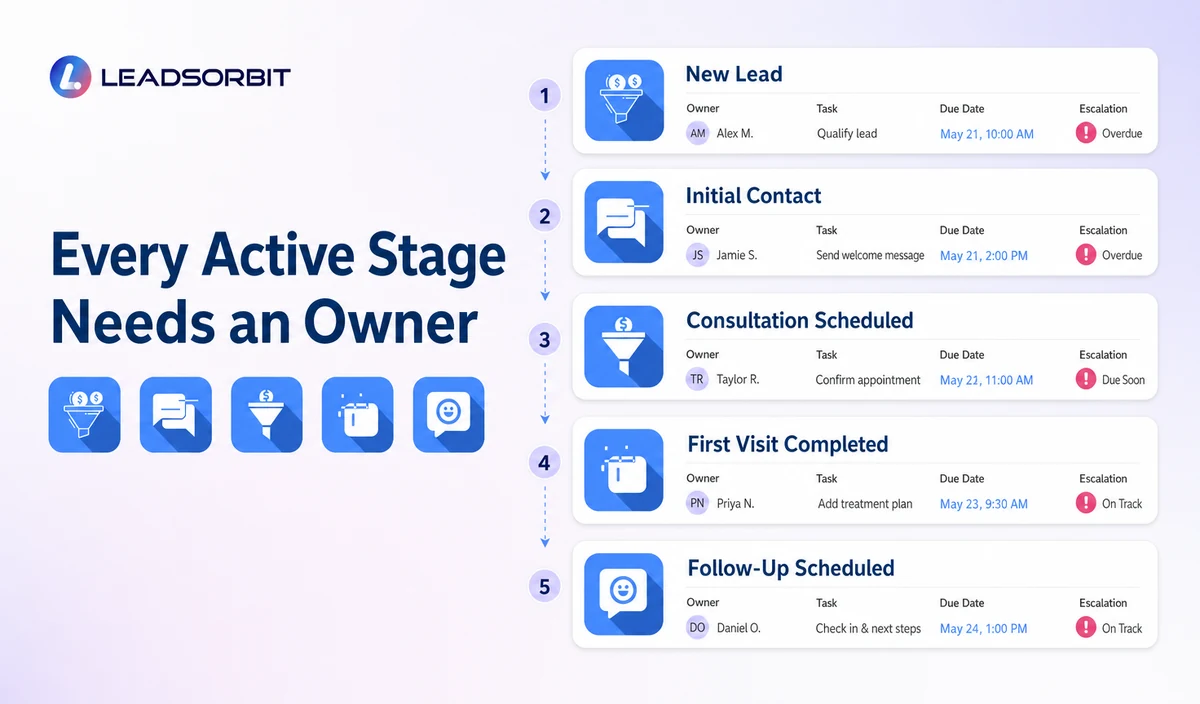
Every active stage should have an owner, a backup owner, and a practical service rule. Automation may create the task, but the team still needs to know who reviews exceptions.
| Stage group | Primary owner | Example service rule | Escalation |
|---|---|---|---|
| New Inquiry / Attempted Contact | Front desk or assigned lead response owner | Review during the defined business window. | Escalate unassigned or failed delivery records. |
| Engaged / Appointment Requested | Booking owner | Respond to appointment questions and exceptions. | Escalate provider/location/calendar exceptions. |
| Booked / Confirmed | Scheduling owner | Monitor confirmations, changes, and reminders. | Escalate repeated failures or sensitive requests. |
| No Show / Cancelled | Rescheduling owner | Apply respectful recovery and stop rules. | Escalate complaints, clinical questions, or repeated exceptions. |
| Nurture / Reactivation | Marketing or operations owner | Review segments, consent, cadence, and outcomes. | Pause campaigns with confusion or compliance concerns. |
| Closed | Office manager or data owner | Maintain accurate closure reasons and suppress inappropriate follow up. | Reopen only with a valid new interaction. |
Automation Rules by Stage
Workflow AI can support conditions, tasks, messages, and stage changes when configured. Stage movement should not be hidden or irreversible. Staff need to understand why a record moved.
- New Inquiry: create owner task and approved acknowledgment.
- Attempted Contact: schedule the next limited follow up and stop after reply or opt out.
- Engaged: notify the owner and pause generic no response messages.
- Appointment Requested: create a booking review task when automatic booking cannot complete.
- Booked: stop acquisition messages and start the approved confirmation and reminder workflow.
- Confirmed: suppress duplicate confirmation messages.
- No Show / Cancelled: start the separate recovery workflow only when appropriate.
- Nurture: use approved timing and communication preferences.
- Closed: stop active automation unless a new valid trigger occurs.
Pipeline Fields That Help Without Becoming a Clinical Record
A pipeline needs enough information for administrative follow up, but more fields do not automatically improve performance. Every field should have a defined operational purpose.
| Useful operational field | Purpose | Caution |
|---|---|---|
| Inquiry source | Understand where the contact began. | Do not imply perfect attribution unless verified. |
| Assigned owner | Make follow up responsibility visible. | Use backup ownership for absences. |
| Preferred contact channel | Respect communication preference. | Maintain consent and opt out status. |
| New or existing patient status | Select the correct administrative branch. | Do not infer clinical status. |
| Requested location or provider | Route booking appropriately where supported. | Do not promise availability. |
| Preferred day or time | Support appointment requests. | Avoid unnecessary detail in shared calendars. |
| Next task and due date | Make the next action clear. | Escalate overdue active tasks. |
| Closure reason | Improve data quality and suppression rules. | Keep choices simple and nonjudgmental. |
HIPAA Enabled Administrative Pipeline Positioning
LEADSORBIT supports HIPAA compliant administrative workflows for eligible healthcare organizations through HIPAA enabled HighLevel subaccounts. Compliant use depends on maintaining the active HIPAA package, applicable agreements, approved account configuration, user permissions, integrations, retention settings, and the healthcare organization’s own procedures.
Use minimum contact and operational information. Identifiable contact, appointment, and communication history may still be PHI in a healthcare context. The pipeline should not store detailed symptoms, diagnoses, treatment records, SOAP notes, imaging, claims, or other unnecessary clinical information.
Review the HHS Privacy Rule overview and minimum necessary guidance with qualified advisers. Every connected form, calendar, communications provider, AI tool, storage system, and data destination requires separate review.
Pipeline Reporting That Actually Helps
Reporting should help the clinic find bottlenecks. Avoid vanity dashboards and unsupported benchmarks.
- New inquiries by source.
- Records without an assigned owner.
- Attempted Contact records beyond the clinic’s review window.
- Engaged inquiries without a next task.
- Appointment requests waiting for staff review.
- Booked versus confirmed administrative status.
- No shows and cancellations awaiting an approved next step.
- Nurture records due for review.
- Closed records without a valid reason.
- Duplicate contacts and inconsistent stage usage.
Pipeline Setup Checklist
- Choose the minimum stage set and define each stage in one sentence.
- Write an entry rule and exit rule for every stage.
- Assign a primary and backup owner.
- Define the next task and service rule for active stages.
- Separate Appointment Requested, Booked, and Confirmed.
- Create distinct No Show, Cancelled, Nurture, Reactivation, and Closed rules.
- Stop acquisition follow up after booking or staff takeover.
- Keep clinical details outside the administrative pipeline.
- Review forms, calendars, integrations, permissions, and retention.
- Audit stage accuracy weekly during launch.
See the Pipeline With Your Clinic’s Workflow
Book a Demo to map your chiropractic inquiry stages, owners, booking handoffs, task rules, no response logic, and reporting inside LEADSORBIT.
How LEADSORBIT Supports Chiropractic Pipeline Management
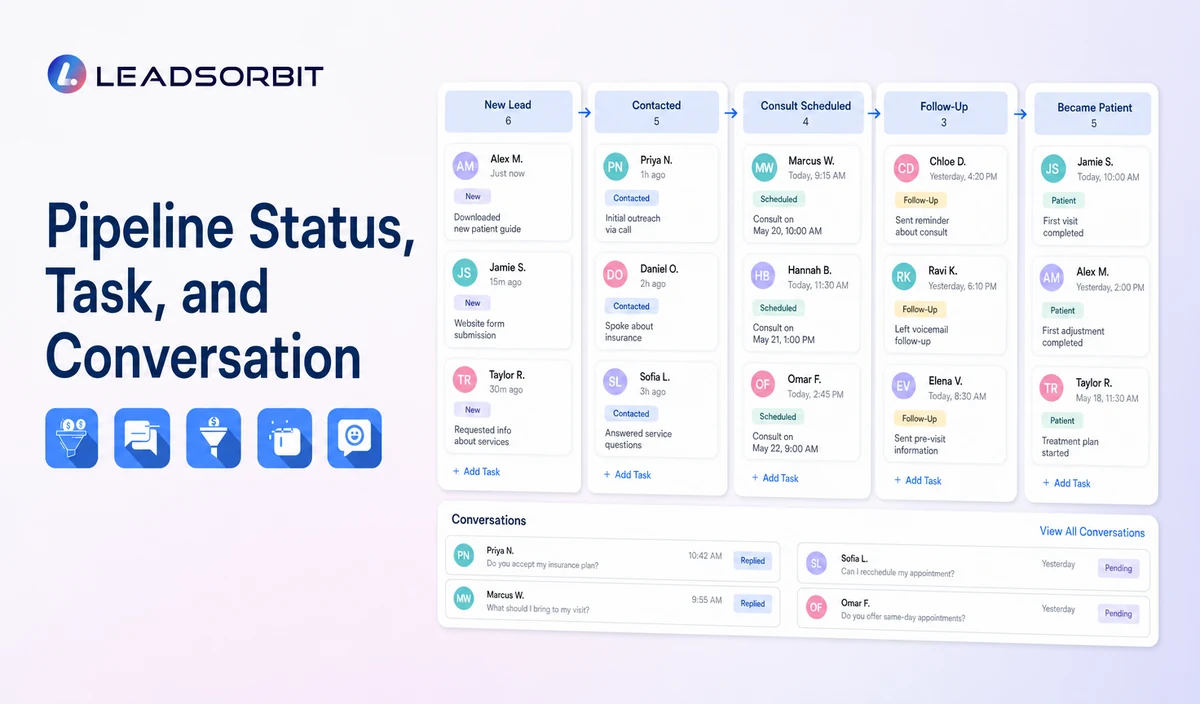
LEADSORBIT’s AI powered CRM connects contact records, conversations, tasks, booking activity, workflow conditions, and pipeline status.
Workflow AI: supports conditions, messages, tasks, timing, and approved stage-related actions.
Conversation AI: supports conversation history, routing, staff takeover, and CRM synchronization.
AI Appointment: supports booking, confirmations, rescheduling, and cancellation paths that can inform administrative stage updates.
CRM pipeline and task visibility: supports owners, statuses, next actions, and operational reporting.
Exact automatic stage movement, reporting fields, permissions, integrations, and account configuration must be validated before publication or deployment.
Try LEADSORBIT free for 14 days
Frequently Asked Questions
A practical stage set includes New Inquiry, Attempted Contact, Engaged, Appointment Requested, Booked, Confirmed, Completed, No Show or Cancelled, Nurture, Reactivation, and Closed.
Final Thoughts
The right chiropractic CRM pipeline makes ownership visible. Each stage should tell the team what has happened, what must happen next, and when automation should stop.
Book a Demo to see how LEADSORBIT can organize chiropractic inquiries, booking status, tasks, conversations, and stage reporting.

Start Your Free 14 Day Trial
Try LEADSORBIT and see how it captures missed calls, follows up instantly, and turns leads into booked appointments for your business.