
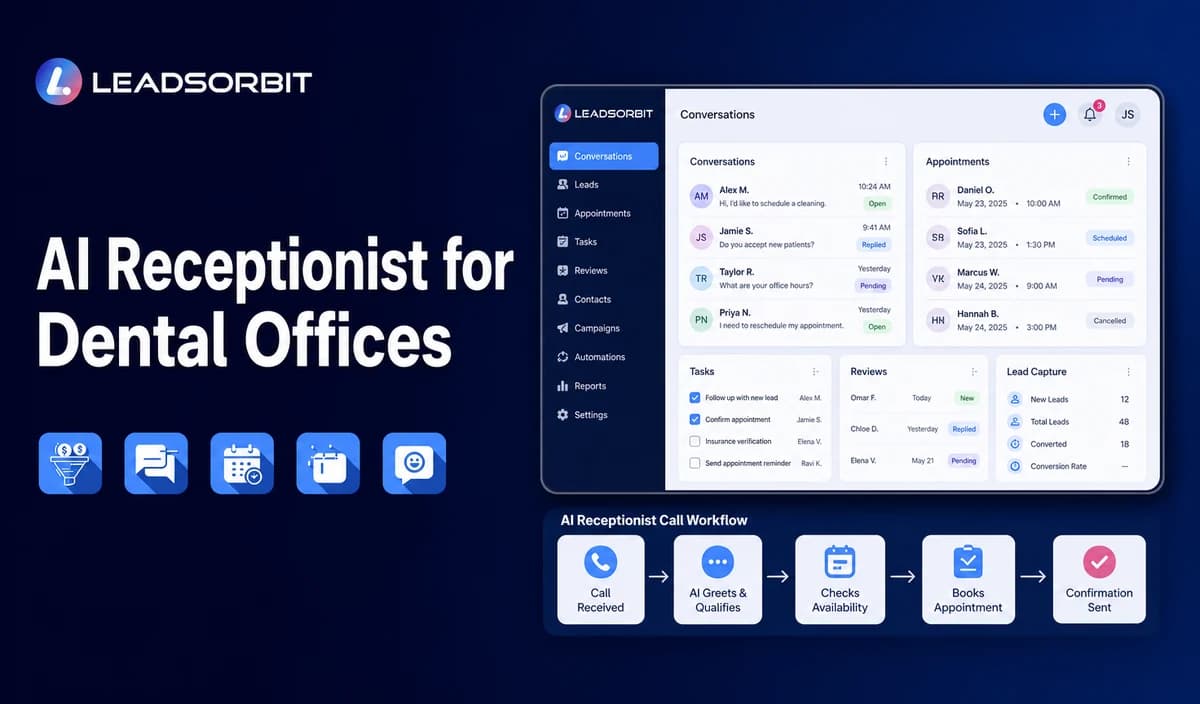

Dental front desks handle more than phone calls. The same team may be checking in patients, coordinating schedules, answering office questions, processing appointment changes, and supporting providers. An AI receptionist for dental offices can handle routine first contact tasks so callers receive a clear next step even when staff are busy or the office is closed.
This guide focuses on administrative call handling for dental practices. It is narrower than the general AI receptionist for clinics guide and does not position LEADSORBIT as a dental practice management system, EHR, charting, billing, claims, imaging, or treatment planning platform. The commercial dental destination remains LEADSORBIT Dental Software.

Who This Guide Is For
- Solo dental practices and group practices with busy front desks.
- Dental offices receiving new patient inquiries during appointments or after business hours.
- Teams that need consistent phone routing, appointment requests, and callback ownership.
- Practices that want calls, messages, booking activity, and tasks visible in a CRM workflow.
- Healthcare organizations reviewing HIPAA enabled administrative call handling.
What an AI Receptionist Can Handle in a Dental Office
The best starting point is a short list of approved front desk tasks. The AI should complete routine administrative work and hand off anything requiring professional judgment, sensitive information, or office specific discretion.
| Appropriate administrative task | Typical next step | Human review needed when |
|---|---|---|
| Identify new or existing patient status | Choose the correct call branch. | The record is unclear, duplicated, or sensitive. |
| Provide approved office hours, location, parking, and contact details | Answer the routine question or send approved information. | The information is unavailable or may have changed. |
| Capture an appointment request | Offer an approved booking path or staff callback. | The appointment type, provider, location, or time needs review. |
| Support rescheduling or cancellation | Use the approved change path. | The request cannot be completed from the connected calendar. |
| Collect minimum contact and operational information | Create or update the CRM record and task. | The caller begins sharing clinical, billing, insurance, or record details. |
| Route to the correct staff member | Transfer or create a named callback task. | The caller asks for a person, complains, or uses predefined escalation language. |
A Practical Dental AI Receptionist Call Workflow
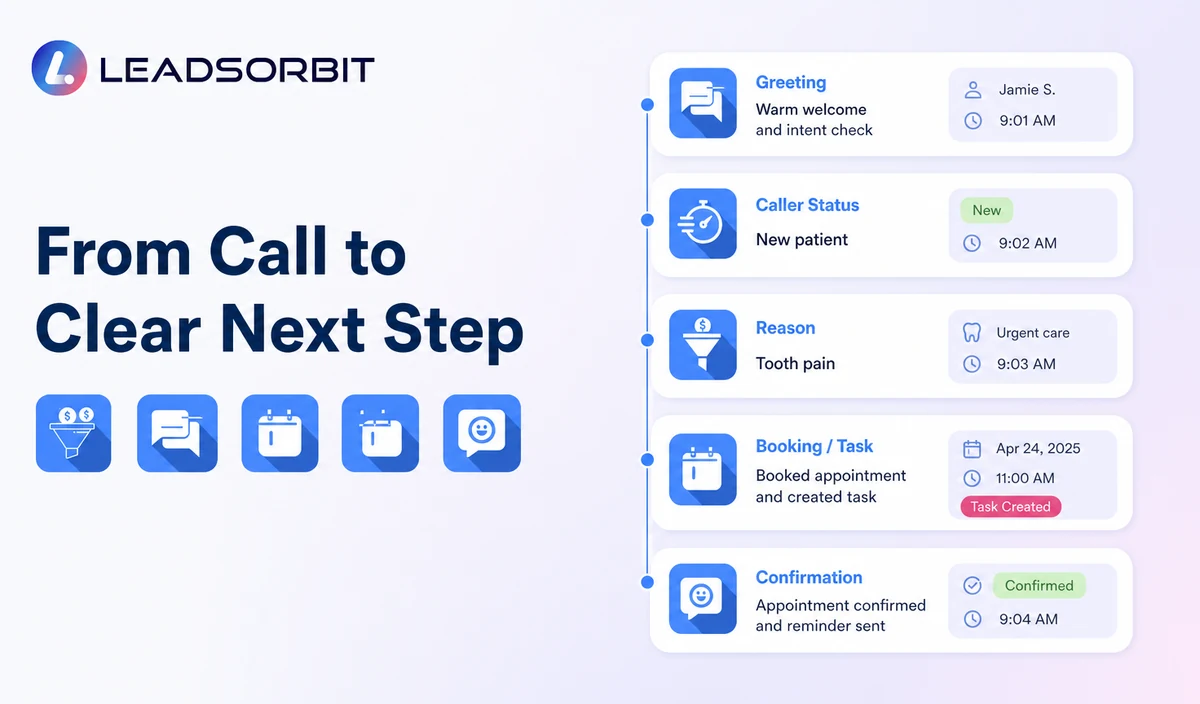
| Stage | AI receptionist action | Staff responsibility | Stop or escalation rule |
|---|---|---|---|
| 1. Greeting and identification | Use the approved dental office greeting and explain the available administrative help. | Keep the greeting and office information current. | Transfer when the caller requests a person under the clinic’s rules. |
| 2. New or existing patient | Ask whether the caller is new or has visited the practice before. | Define the correct workflow for each status. | Do not force an existing patient through new patient questions. |
| 3. General reason | Offer choices such as appointment request, appointment change, general office question, or staff callback. | Approve the available categories and answers. | Stop routine questions when the caller raises clinical or sensitive issues. |
| 4. Minimum details | Confirm name, callback information, preferred location/provider where relevant, and preferred time. | Review field purpose, permissions, and data retention. | Avoid detailed symptoms, diagnosis, records, treatment, claims, or payment card information. |
| 5. Booking or task | Offer the approved appointment path or create a named staff task. | Own exceptions and unresolved requests. | Stop after valid booking, staff takeover, or documented closure. |
| 6. Confirmation | State the approved next step and realistic timing. | Monitor failed transfers, tasks, and booking errors. | Do not promise availability or callback timing the office cannot meet. |
| 7. CRM visibility | Record the call activity and operational context when enabled and configured. | Review permissions, transcription, retention, and integrations. | Restrict access and correct inaccurate summaries or fields. |
New Patient and Existing Patient Calls Need Different Branches
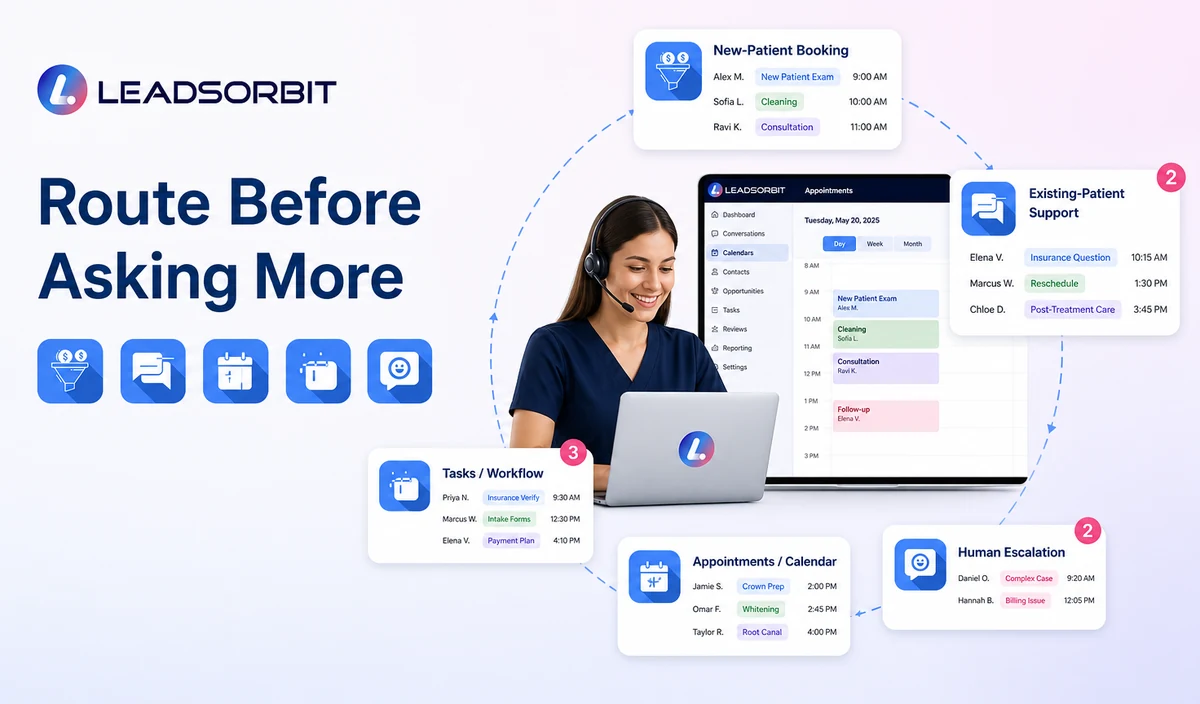
A new caller may need an appointment path and basic office information. An existing patient may need help with an appointment, an office question, records contact, billing contact, insurance contact, or a staff callback. The AI should route those requests without attempting to resolve specialized or clinical matters.
| Caller type | Useful questions | Next step | Avoid |
|---|---|---|---|
| New patient | Name, callback, general request, location/provider preference where relevant, preferred time. | Approved booking path or staff callback. | Detailed symptoms, diagnosis, treatment suitability, insurance determinations, or clinical intake. |
| Existing patient | Name, callback, appointment change or general office reason. | Existing patient scheduling branch or staff task. | Repeating full new patient intake or exposing another person’s information. |
| Parent or guardian | Caller identity, patient relationship where needed, general administrative request. | Use the practice’s approved guardian/minor workflow. | Assuming authority or collecting unnecessary clinical detail. |
| Professional office or vendor | Organization, callback details, general administrative purpose. | Route to the approved office contact. | Clinical records transfer or agreement decisions through routine AI. |
| Caller with clinical or escalation language | Minimum callback information when appropriate. | Predefined message, transfer, or priority staff task. | Diagnosing, triaging, interpreting urgency, or recommending treatment. |
Routine Dental Office Questions the AI May Answer
Only approved, current information should be available to the AI. The office should assign an owner to review the knowledge base whenever hours, locations, providers, policies, or links change.
- Office hours and holiday closures.
- Address, parking, entrance, and accessibility information.
- General appointment request options.
- How to request rescheduling or cancellation.
- Whether the office is accepting new patient inquiries, when verified.
- General forms or check in instructions approved for the channel.
- The correct staff contact for records, billing, insurance, complaints, or other specialized questions.
- A realistic callback expectation based on office hours.
After Hours Dental Call Handling
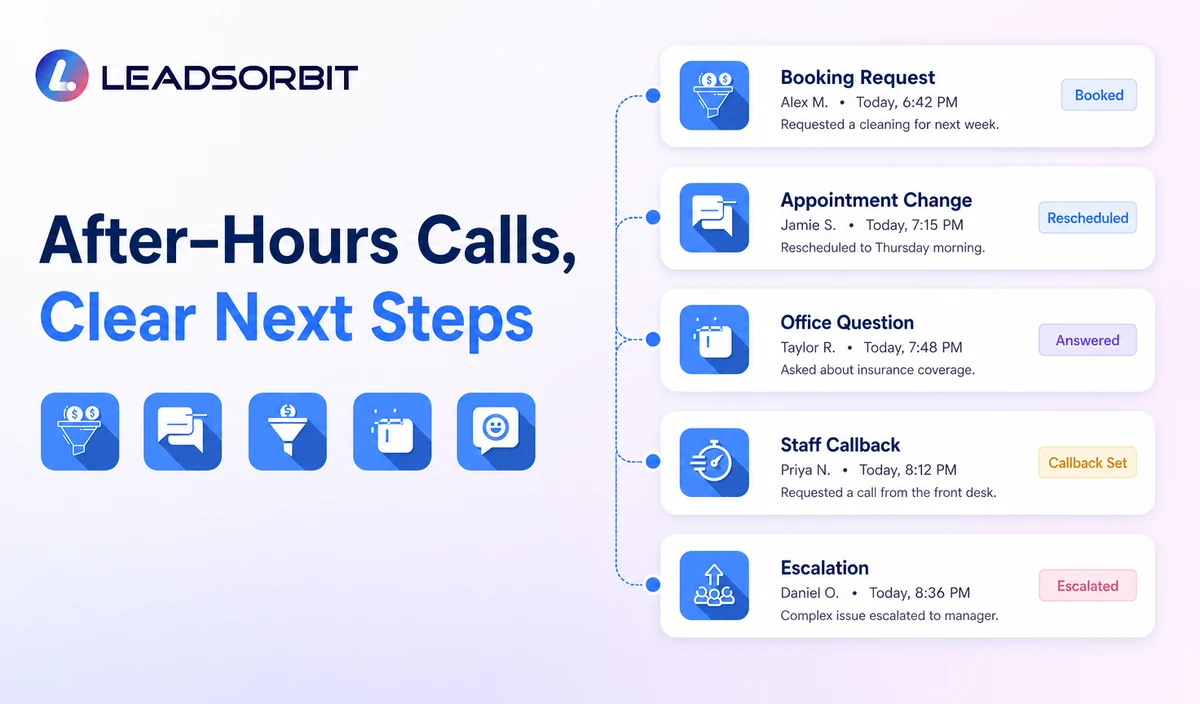
After hours coverage should be transparent. The AI should identify that the office is closed, provide approved administrative options, and use the practice’s predefined escalation message without making medical urgency decisions.
| After hours call | Approved handling | Do not |
|---|---|---|
| New appointment inquiry | Capture minimum details and offer the approved booking or next business period callback path. | Promise same day treatment or provider availability. |
| Existing appointment change | Record the request or offer the approved change path. | Confirm a new time before the calendar shows a valid booking. |
| General office question | Answer from the approved knowledge base or create a task. | Guess about insurance, billing, records, treatment, or policies. |
| Clinical concern or escalation language | Stop routine intake and present the clinic’s predefined message or transfer path. | Decide whether the situation is an emergency or recommend clinical action. |
| Caller asks for a person | Create the correct callback or transfer under the office’s rules. | Continue asking unnecessary questions. |
HIPAA Enabled Administrative Call Handling
LEADSORBIT supports HIPAA compliant administrative workflows for eligible healthcare organizations through HIPAA enabled HighLevel subaccounts. Compliant use depends on maintaining the active HIPAA package, applicable agreements, approved account configuration, user permissions, integrations, retention settings, and the healthcare organization’s own procedures.
Names, phone numbers, appointment requests, call activity, recordings, transcripts, summaries, and communication history may be PHI depending on the healthcare context. Use minimum contact and operational information and review the specific subaccount, agreements, permissions, retention, call recording, transcription, calendar, messaging, AI, and integration settings.
The HHS Privacy Rule overview and minimum necessary guidance provide the official healthcare privacy context. The clinic should obtain qualified legal and compliance advice for its exact use.
When the AI Receptionist Should Hand Off to Staff
- The caller asks to speak with a person.
- The caller shares symptoms, a diagnosis, treatment questions, or medical history.
- The caller asks whether a dental procedure is appropriate.
- The caller uses the practice’s predefined escalation or emergency language.
- The caller asks about records, claims, billing disputes, coverage, or clinical documentation.
- The appointment request requires provider, location, accessibility, or office policy review.
- The AI does not have a current approved answer.
- A transfer fails, a task becomes overdue, or the caller is dissatisfied.
Dental AI Receptionist Setup Checklist
- List the routine call reasons the AI may handle.
- Write separate new patient and existing patient branches.
- Approve office hours, locations, parking, forms, appointment links, and callback expectations.
- Define the minimum contact and appointment fields.
- Create booking, rescheduling, cancellation, general question, staff callback, and escalation paths.
- Assign a primary and backup owner for every unresolved task.
- Confirm whether recording, transcription, summaries, and retention are enabled.
- Review the HIPAA enabled subaccount, applicable agreements, permissions, and integrations.
- Test after hours calls, failed transfers, unclear answers, staff takeover, and sensitive replies.
- Review real calls and correct scripts without expanding into clinical intake.
See the Dental Front Desk Workflow With Your Rules
Book a Demo to map your dental office greeting, new versus existing patient branches, routine answers, booking paths, callback owners, escalation language, and healthcare data controls inside LEADSORBIT.
What to Measure After Launch
- Calls answered and calls transferred to staff.
- New patient and existing patient call volume.
- Appointment requests moved to booking or staff review.
- General questions answered from approved content.
- Failed transfers and overdue callback tasks.
- Calls requiring clinical, sensitive, complaint, records, billing, or insurance handoff.
- Recording/transcription errors and staff corrections.
- Caller opt outs, complaints, confusion, or privacy concerns.
- Staff feedback about workload and call context.
How LEADSORBIT Supports Dental Call Handling
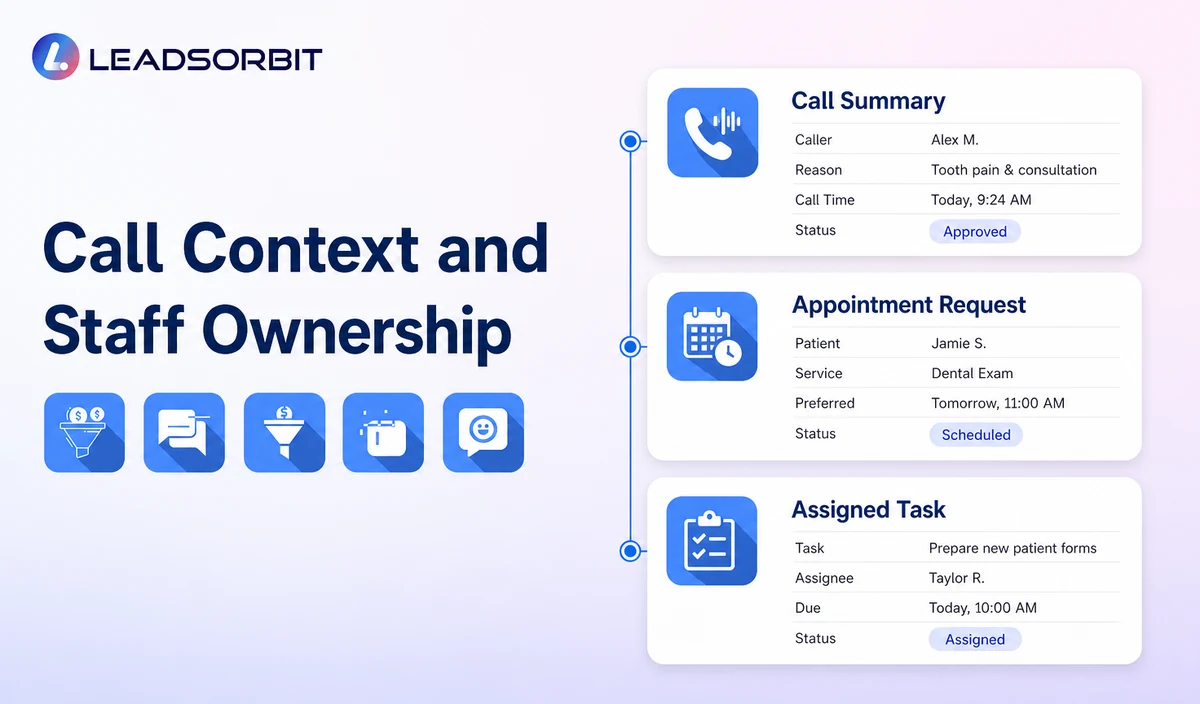
LEADSORBIT’s AI powered CRM can connect inbound call handling, approved questions, appointment paths, conversation context, tasks, and contact records.
- AI Receptionist: supports 24/7 call answering, approved questions, contact capture, appointment booking, and after hours handling.
- Conversation AI: supports conversation visibility, routing, staff takeover, and CRM synchronization across configured channels.
- AI Appointment: supports online booking, calendar connections, confirmations, rescheduling, and cancellation.
- CRM records and tasks: support call activity, assigned owner, next action, and operational status.
Exact call flows, numbers, appointment types, calendars, recording, transcription, summaries, permissions, retention, and integrations must be verified during configuration. LEADSORBIT is positioned here as the administrative communication and CRM layer, not a dental PMS, EHR, charting, billing, claims, imaging, or treatment planning system.
Try LEADSORBIT free for 14 days
FAQs
It handles approved routine calls, identifies caller status and intent, captures minimum operational details, offers booking or callback paths, and routes non routine requests to staff.
Final Thoughts
An AI receptionist for dental offices works best when it handles a short list of approved administrative tasks, separates new and existing patients, offers a clear booking or callback path, and hands off clinical or sensitive requests without guessing.
Book a Demo to see how LEADSORBIT can support dental calls, appointment requests, after hours inquiries, staff tasks, and front desk visibility.

Start Your Free 14 Day Trial
Try LEADSORBIT and see how it captures missed calls, follows up instantly, and turns leads into booked appointments for your business.