
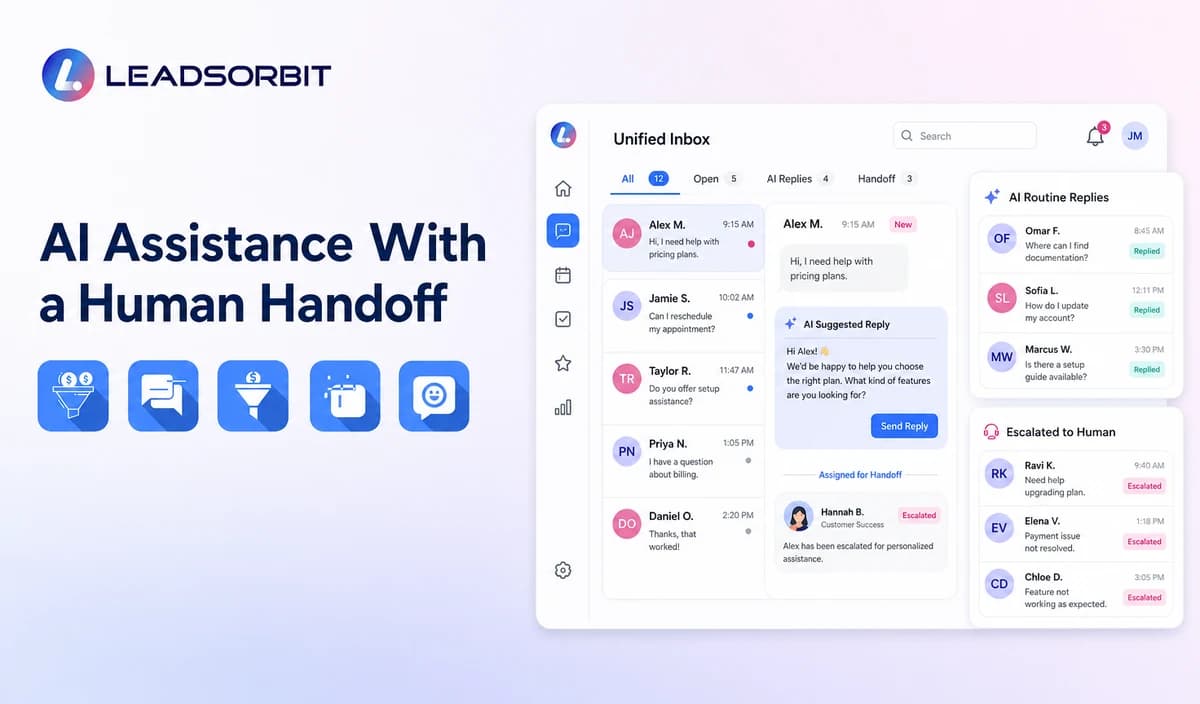

Small business customer service happens across calls, text, email, chat, appointments, and social channels. Customers expect the team to understand the situation even when the conversation moves.
AI can help provide a first response, summarize history, answer approved routine questions, and route requests. It works best inside a connected AI CRM for small business.
What Is AI Customer Service for Small Business?
AI customer service uses artificial intelligence to assist customer communication and service workflows. It may interpret questions, retrieve approved information, draft replies, summarize conversations, classify requests, create tasks, or route customers.
The goal is not to make every interaction automated. It is to reduce repetitive work while preserving human ownership for complex or sensitive situations.
Where Customer Service Becomes Disconnected
Service problems often begin when conversations and tasks are separated.
- Customers contact the business through several channels.
- Staff cannot see earlier messages.
- Routine questions consume repeated effort.
- Complaints are not assigned quickly.
- Appointment changes are separated from the record.
- The same customer receives conflicting answers.
- No one reviews outdated knowledge.
AI can support continuity only when conversations, records, tasks, and ownership stay connected.
The AI Assisted Customer Service Workflow
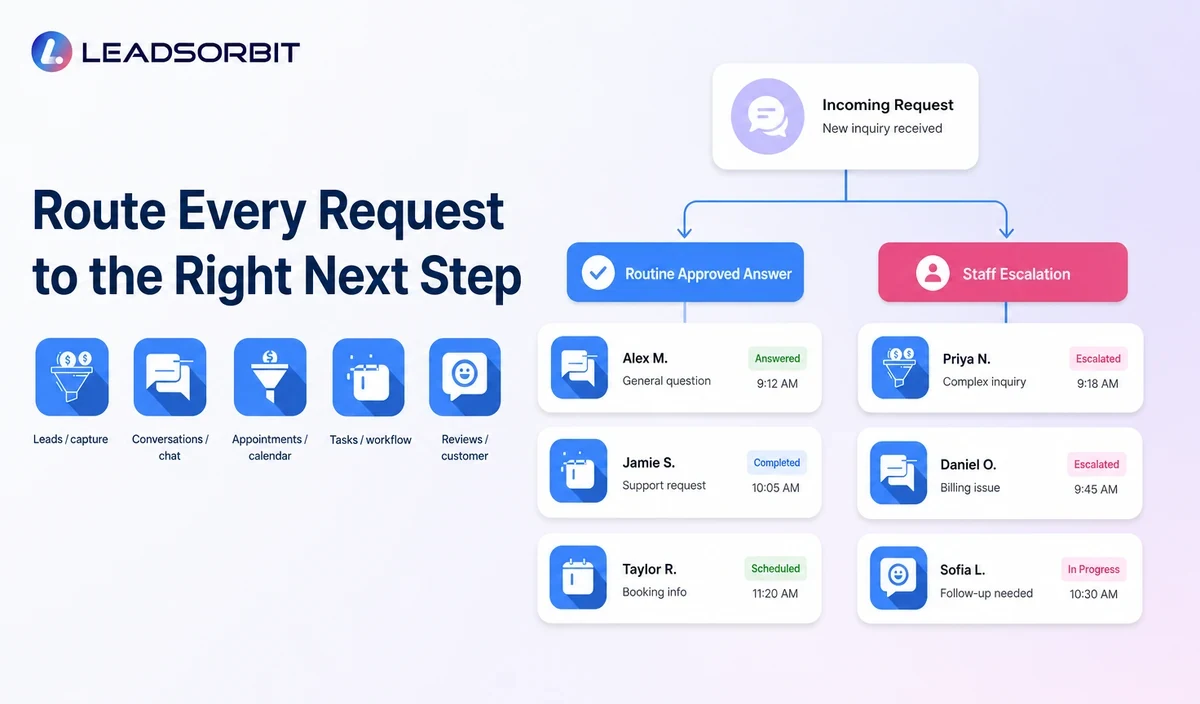
A complete workflow connects the customer request with approved information and the right owner.
- A customer contacts the business through a supported channel.
- The CRM finds or creates the customer record.
- AI identifies the request and retrieves approved context.
- The system answers a routine question, drafts a response, or acknowledges the issue.
- A task or handoff is created when staff action is required.
- The employee sees the conversation and continues without making the customer repeat it.
- The result and next action remain attached to the record.
The customer should always have a clear way to reach a person.
AI Customer Service vs a Chatbot
A chatbot can be part of customer service, but it is not the entire system.
| Chatbot | AI Customer Service System |
|---|---|
| Primarily a conversation interface. | Connects conversations with CRM records, tasks, appointments, routing, and reporting. |
| May answer from a limited knowledge set. | May combine approved knowledge with customer context and rules. |
| Often remains inside one channel. | Can support a journey across calls, messages, email, chat, and booking. |
| May end when the chat ends. | Preserves history and creates the next action. |
The value comes from what happens after the answer, not only from the chat experience.
Where AI Can Support Customer Service
AI can assist first response, routine questions, conversation summaries, request classification, appointment support, task creation, and follow up.
- Acknowledge without pretending the issue is resolved.
- Use only approved routine information.
- Keep original messages available beside summaries.
- Route uncertainty and exceptions to staff.
Knowledge and Answer Quality
The business should maintain hours, services, locations, booking rules, policies, contact methods, and common answers.
- Assign a knowledge owner.
- Review high use answers.
- Remove outdated or conflicting information.
- Define topics the AI must not answer.
- Test unclear and unsupported questions.
Privacy, Confidentiality, and Access
Customer conversations may contain sensitive details. Businesses should understand what information the AI processes, where it is stored, how long it is retained, and who can access it. Review the FTC AI privacy guidance.
Measuring Service Quality
Do not measure success only by the percentage of conversations handled without a person.
A high automation rate can hide unresolved or poorly handled requests.
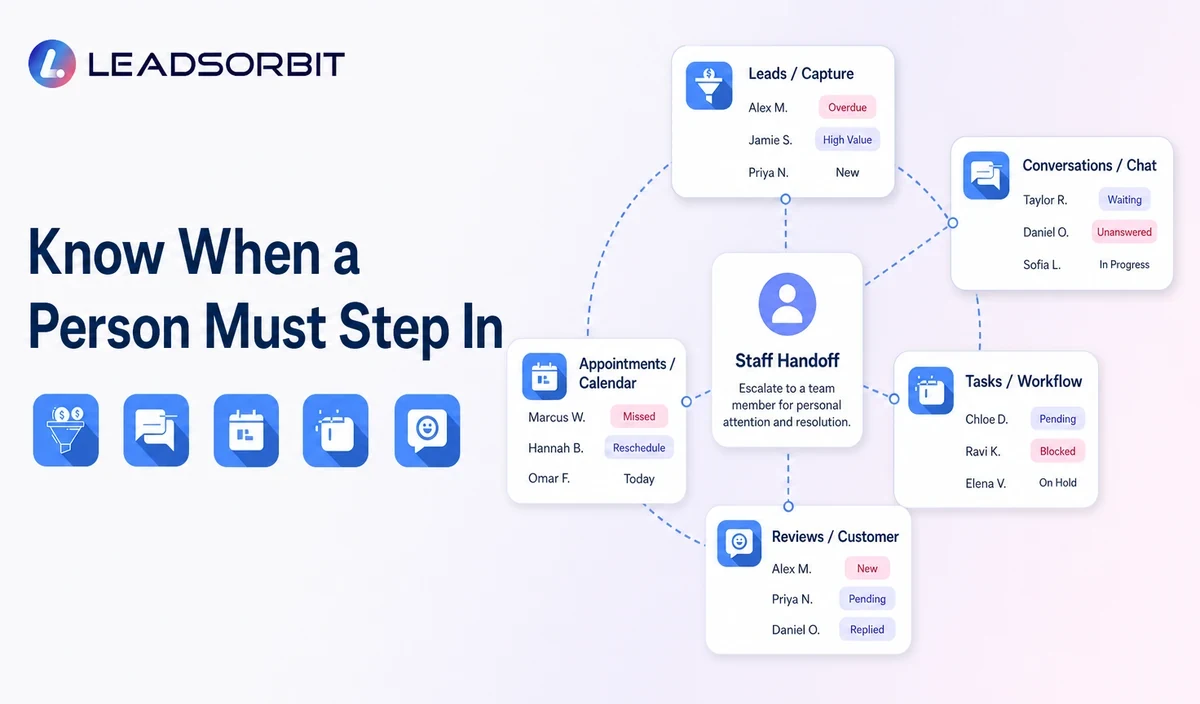
When AI Should Hand Off to a Person
The business should define clear escalation conditions.
- The customer asks for a human.
- The answer is uncertain or outside approved information.
- The customer is upset or disputes a charge or service.
- The request is sensitive, urgent, or safety related.
- The conversation requires professional judgment.
- The issue involves an exception or custom pricing.
- The customer has repeated the request without resolution.
- The customer received conflicting information.
The handoff should be visible, assigned to an owner, and supported by a useful summary.
How to Evaluate AI Customer Service Software
Use real service requests in the demonstration.
- Ask a routine approved question.
- Ask an unsupported and ambiguous question.
- Request a person and show the transfer.
- Open the original conversation beside the summary.
- Create and assign a service task.
- Change an appointment.
- Review the activity log and exception report.
- Confirm knowledge ownership, permissions, retention, and support.
The system should make uncertainty and outstanding work visible.
Implementation Steps
Begin with a small set of routine topics.
- List common questions and service requests.
- Choose approved routine topics.
- Clean knowledge sources and assign an owner.
- Define answer boundaries and mandatory handoffs.
- Connect conversations to records and tasks.
- Test normal, unclear, sensitive, and unsupported requests.
- Train staff to monitor, correct, and take over.
- Launch with limited scope and review transcripts.
Expand the knowledge and workflows only after the initial service remains accurate.
What to Measure
Measure both speed and resolution quality.
- Time to acknowledgment.
- Time to human resolution.
- Requests answered with approved information.
- Handoff rate and reason.
- Repeated contacts for the same issue.
- Overdue service tasks.
- Incorrect or corrected answers.
- Customer opt outs and complaints.
- Topics creating the most exceptions.
Use customer responses and staff corrections to improve the workflow.
How LEADSORBIT Supports AI Assisted Customer Service
LEADSORBIT connects customer records, conversations, calls, workflows, appointments, tasks, pipeline stages, and reporting in one AI powered CRM.
Conversation AI, AI Receptionist, Workflow AI, and AI Appointment support different customer service paths.
Try LEADSORBIT free for 14 days
Frequently Asked Questions
It can assist routine requests, summaries, first responses, routing, and task creation. Complex or sensitive situations still need people.
Support Customers Without Losing the Human Relationship
AI can help acknowledge requests, provide approved information, summarize context, and route work. The system should remain transparent, controlled, and easy for staff to take over.
Book a Demo to see how LEADSORBIT can connect AI assisted customer service with conversations, tasks, appointments, and CRM records.

Start Your Free 14 Day Trial
Try LEADSORBIT and see how it captures missed calls, follows up instantly, and turns leads into booked appointments for your business.